
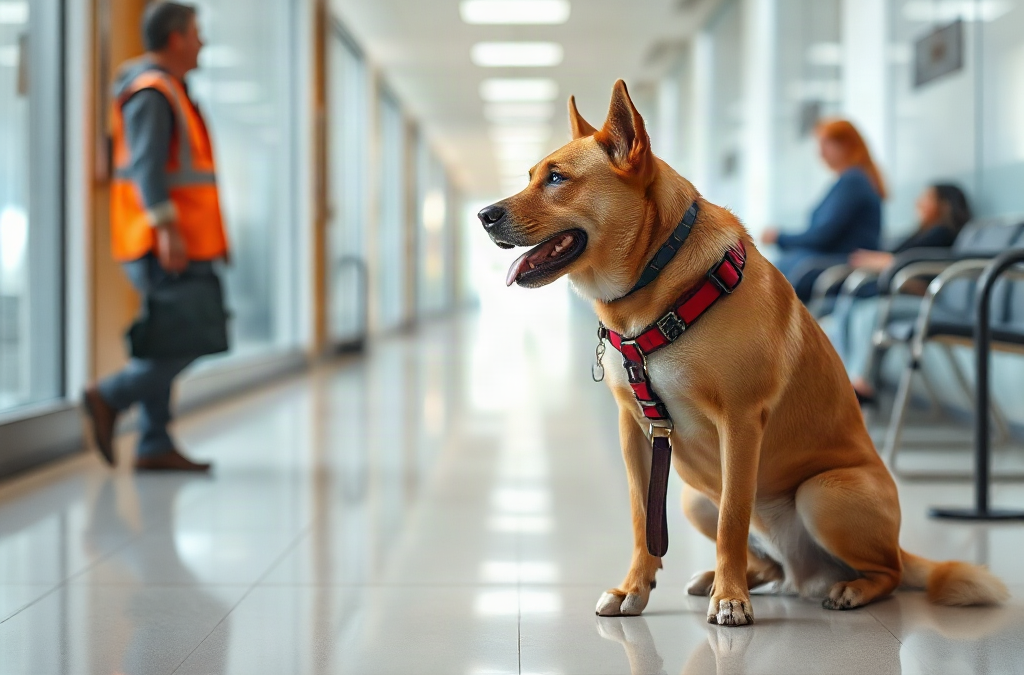
Disaster plans for service animal access should keep the handler and animal together through evacuation, transportation, shelter intake, relief areas, and temporary lodging. The plan should document the animal’s essential tasks and care routine without relying on certification papers, which may not exist or be required in every setting. Pack food, water, medication, harnesses, cleanup supplies, veterinary information, and backup handling instructions in an accessible kit. Confirm accessible transport and shelter procedures before an incident, identify alternate destinations, and plan for relief breaks and heat or smoke exposure. A workable plan also prepares for separation, injury, or a handler who temporarily cannot direct the animal.
What you’ll learn
This guide covers the following practical points:
- Map Access Across the Disaster Route — A service animal access plan must cover the entire route from the point of departure to a safe destination.
- Build a Service Animal Go Kit — The service animal’s supplies should be portable enough to leave quickly but complete enough to bridge interrupted services.
- Prepare for Shelter Intake and Daily Needs — Shelter intake works better when staff can quickly understand what the team needs without demanding a lengthy explanation in a crowded reception area.
- Create Backup Plans for Disruption or Separation — Contingencies should address both the animal’s needs and the disability-related consequences of losing its assistance.
Map Access Across the Disaster Route
A service animal access plan must cover the entire route from the point of departure to a safe destination. A shelter address alone does not resolve how the team will reach transportation, pass through intake, find an appropriate relief area, or obtain food and water after arrival. Write down each transition and identify who is responsible for solving it.
Start with the hazards most likely to change normal travel. Floodwater may close an accessible sidewalk, smoke may make an outdoor wait unsafe, and a power failure may disable elevators or electronic doors. A person who normally uses public transit should identify at least two alternate transport options and confirm that each can accommodate the handler, mobility equipment, animal, and go kit. Avoid assuming that a friend’s available car has enough space or that a pickup point will remain accessible.
Potential destinations should include more than a public shelter. Consider an accessible hotel outside the affected area, a trusted household, or another designated facility. Call local emergency management before an incident to ask how accessible transportation is requested, where shelter updates are published, and how service animal teams are handled at reception. Policies and operating locations may change during an event, so save multiple contact methods rather than treating an old address as a guarantee.
A useful route worksheet records the primary destination, two alternatives, transport contacts, likely barriers, relief locations, and a meeting point if communications fail. The common failure is mapping only the shortest route. A longer route with accessible boarding, safer footing, and an indoor waiting area may be the more dependable choice.

Build a Service Animal Go Kit
The service animal’s supplies should be portable enough to leave quickly but complete enough to bridge interrupted services. Store the kit near the handler’s own emergency bag, with frequently needed items reachable without emptying the entire container. Weight matters: an oversized supply bin may be useless if the handler cannot carry or load it independently.
Pack supplies for the animal’s normal feeding, medication, sanitation, work, and rest routines. A compact checklist includes:
- Food, drinking water, collapsible bowls, and a manual can opener if needed
- Prescribed medication, dosing instructions, and temperature-safe storage where applicable
- Working harness or other usual equipment, plus a familiar leash and backup restraint
- Waste bags, absorbent material, grooming items, and cleaning supplies
- A mat or blanket that provides a recognizable resting place
- Veterinary contact details, vaccination records, identification photos, and emergency contacts
- Written care and handling notes for a trusted backup person
Identification records are useful if the team becomes separated, but the kit should not imply that identification documents determine whether an animal is a service animal. Access rules can vary by jurisdiction and facility type, and emergency conditions may complicate implementation. Handlers and planners should consult current official guidance applicable to their location rather than buying unofficial certificates or registries.
Rotate food, water, and medication before they expire, and check batteries or tracking devices if used. A good kit can be lifted, opened, and used under the handler’s actual mobility constraints. If it cannot, divide it into a carry-now bag and a larger replenishment container for vehicle transport.
Prepare for Shelter Intake and Daily Needs
Shelter intake works better when staff can quickly understand what the team needs without demanding a lengthy explanation in a crowded reception area. Prepare a short written statement naming the animal’s trained work or task, the handler’s communication needs, essential equipment, relief schedule, and any environmental issue that affects safe placement. It should be readable under stress and should not disclose unrelated medical details.
Daily operations matter as much as admission. Ask where the animal can relieve itself, how the route is reached after dark, whether water is available, and where food or medication can be stored. A relief area that requires crossing debris, climbing stairs, or navigating an unlit parking lot may be inaccessible even if one technically exists. Shelter planners should evaluate the path, surface, lighting, waste disposal, and reentry process.
Shared environments create practical constraints. Other occupants may have allergies, fear of animals, or their own service animals. Separation by distance, airflow, or room arrangement may be workable; excluding the service animal or separating it from its handler should not be treated as the automatic solution. Local authorities and facility operators should use current disability-access guidance when resolving competing needs.
For example, a handler who needs an outdoor relief trip every four hours may arrive during a severe storm. The plan should identify a staff contact, the safest available route, protective gear, and an indoor contingency for cleanup if going outside becomes temporarily dangerous. The weak assumption is that ordinary routines remain possible throughout the incident.
Create Backup Plans for Disruption or Separation
Contingencies should address both the animal’s needs and the disability-related consequences of losing its assistance. Illness, injury, panic, damaged equipment, or accidental separation may temporarily prevent the animal from working. The handler may then need human assistance, mobility support, navigation help, communication accommodations, or another task-specific alternative.
Choose at least one person who understands how to feed, relieve, transport, and safely handle the animal if the handler cannot do so. Written instructions should explain normal commands, known stress signals, medication requirements, and actions the backup person must avoid. Practice transferring the leash or harness where appropriate; an unfamiliar person reading instructions for the first time during an evacuation is not a reliable safeguard.
Carry recent photos showing the handler and animal together, along with microchip or identification information if applicable. Establish who will contact shelters, animal-control agencies, veterinary clinics, and emergency management if separation occurs. Do not put all records on a phone that may lose power or connectivity; retain a paper copy and an offline digital copy.
Some conditions may make continued work unsafe for the animal, including contaminated water, sharp debris, extreme heat, heavy smoke, or chemical exposure. The plan should permit the team to pause work and use another accommodation rather than pushing the animal through a hazardous environment. A service animal’s training does not remove ordinary physical limits.
Test and Update the Access Plan
A plan is functioning when the handler can complete its critical steps with available assistance, equipment, and time. Conduct a realistic walk-through: pick up the packed kit, reach the departure point, contact the transport provider, review the destination route, and simulate an intake conversation. Record each point where another person, powered device, internet connection, or inaccessible doorway becomes a single point of failure.
Use a simple review sequence:
- Verify contacts: Confirm transport, destination, veterinary, and backup-handler details.
- Inspect supplies: Replace expired items and confirm that medication storage remains workable.
- Walk the route: Check curb cuts, gates, stairs, lighting, surfaces, and waiting areas.
- Practice communication: Rehearse a concise explanation of access and assistance needs.
- Correct failures: Add an alternative wherever one breakdown would strand or separate the team.
Update the plan after a move, a change in disability-related needs, new animal equipment, a transport change, or revised local shelter arrangements. Signs of failure include unreachable contacts, a kit the handler cannot move, destinations with unverified access, and instructions known only to one person. A successful review produces specific corrections rather than a general sense of readiness.
Conclusion
Effective access planning follows the service animal team through every transition, not merely through a shelter doorway. Verify transport and destinations, assemble a manageable kit, document daily care, and arrange alternatives for separation or interrupted work. Test the route with the equipment and assistance that will actually be available. Any unverified contact, inaccessible relief path, or single-person dependency should trigger a specific backup before the next alert.
Frequently Asked Questions
Should a service animal be included in a household evacuation plan?
Yes. Include the animal in transportation, destination, supply, relief, communication, and backup-assistance decisions. Planning only for the handler can leave an otherwise accessible evacuation unusable.
What records should be carried for a service animal?
Useful records include identification photos, veterinary and vaccination information, medication instructions, emergency contacts, and microchip details if applicable. Check current official access guidance rather than relying on unofficial service-animal certificates.
How much food and medication should the go kit contain?
The amount depends on local emergency guidance, the animal’s needs, carrying capacity, and refill access. Pack a practical initial supply, then arrange a larger reserve or replenishment method if the full amount is too heavy to evacuate.
What if a shelter has residents with animal allergies or fears?
Shelter staff may need to adjust spacing, airflow, routes, or room assignments so competing needs can be addressed. The appropriate arrangement depends on the facility and current disability-access requirements.
What should happen if the service animal cannot work?
The plan should identify temporary human assistance, accessible equipment, communication support, or another task-specific accommodation. Do not require an injured, exhausted, or exposed animal to continue working in unsafe conditions.





