
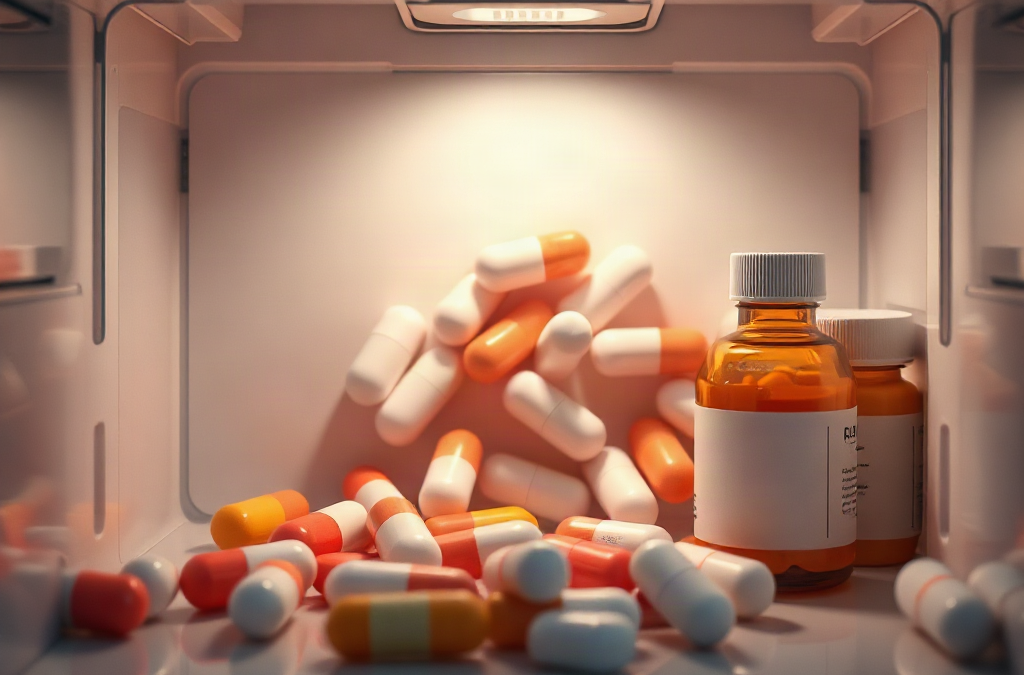
Disaster planning for medication refrigeration failures protects temperature-sensitive medicines by establishing backup cooling, temperature monitoring, and product-specific decision rules before an outage occurs. Record each medicine’s labeled storage range, keep a calibrated thermometer with the supply, and identify a pharmacist or manufacturer contact for excursion guidance. During a failure, keep refrigerator doors closed, avoid direct contact between medicine and ice, and document the highest and lowest temperatures and exposure time. Do not discard or use a questionable product solely by appearance; quarantine it when feasible and obtain professional guidance, especially when a missed or ineffective dose could cause serious harm.
What you’ll learn
This guide covers the following practical points:
- Identify Each Medication’s Refrigeration Requirements — A useful inventory separates medicines that must remain refrigerated from products that may be kept at room temperature for a limited period after opening or removal from refrigeration.
- Build Backup Cooling and Temperature Monitoring — Backup refrigeration should preserve the labeled temperature range without exposing medication to freezing.
- Respond to a Refrigeration Failure — The first response is to stabilize conditions and preserve evidence about the exposure.
- Decide Whether Medication Is Usable — A temperature excursion does not automatically prove that a medicine is unusable, but appearance alone cannot establish that it remains effective.
Identify Each Medication’s Refrigeration Requirements
A useful inventory separates medicines that must remain refrigerated from products that may be kept at room temperature for a limited period after opening or removal from refrigeration. Those conditions are product-specific. Different formulations of a similar medicine may have different limits, so a rule remembered for one insulin, injection, or liquid medication should not be applied to another.
For every refrigerated item, record the exact product name, strength, dosage form, lot number, expiration date, labeled storage range, and whether it has been opened. Add the date on which an opened product was first used. Keep photographs of the package and pharmacy label with the written record, because cartons and inserts may be unavailable during an evacuation.
Ask the dispensing pharmacist what to do if that particular product becomes too warm, freezes, or loses its label. The answer may depend on temperature, duration, packaging, and prior storage history. A common planning mistake is writing only “keep cold,” which gives no usable threshold for making a decision after an outage.
| Planning Record | Why It Matters During a Failure |
|---|---|
| Exact product and formulation | Storage allowances may differ between similar medicines. |
| Labeled temperature range | Defines the conditions against which an excursion is assessed. |
| Opened or unopened status | May change the allowable storage period. |
| Time and temperature log | Helps a pharmacist or manufacturer evaluate exposure. |
| Clinical priority | Guides replacement and continuity decisions when resources are limited. |
Build Backup Cooling and Temperature Monitoring
Backup refrigeration should preserve the labeled temperature range without exposing medication to freezing. A refrigerator connected to a properly operated backup power source may be appropriate at home, while an insulated medication cooler may be more practical during transport. Neither option is reliable without a thermometer that records current temperature and, preferably, minimum and maximum readings.

Cold packs create a frequent failure mode: medication placed directly against a frozen pack may freeze even though the cooler feels suitably cold. Use a barrier, such as insulating material recommended for the container, and keep medicines away from meltwater. Do not use dry ice unless the product manufacturer and container instructions specifically support that method; extremely low temperatures can damage products that must not freeze.
Match equipment to the likely interruption. A short local outage may call for keeping the refrigerator closed and watching the temperature. Evacuation requires a portable container, thermometer, medication list, charging options for powered devices, and a destination where refrigeration has been confirmed. Longer disruptions also require a refill strategy, not simply more ice.
- Primary option: the normal refrigerator with monitored backup power.
- Transport option: an insulated medication carrier with a temperature monitor and freeze protection.
- Replacement option: contact details for the pharmacy, prescriber, insurer, and product manufacturer.
- Documentation: printed and digital copies of prescriptions, labels, and the storage log.
Test the setup with an empty container before relying on it. Place the thermometer where the medicine would sit, load the intended cold packs, and observe whether the temperature stays within the target range. A plan is failing if readings fluctuate outside that range, condensation reaches the medication packaging, or frozen packs touch the intended storage compartment.
Respond to a Refrigeration Failure
The first response is to stabilize conditions and preserve evidence about the exposure. Note when power or cooling was lost, read the thermometer without repeatedly opening the door, and record the current, minimum, and maximum temperatures if available. Avoid transferring products impulsively to an unmonitored cooler; the move may replace a mild warming excursion with damaging freezing.
- Keep the refrigerator closed while checking whether power is likely to return soon.
- Record the outage time and all available temperature readings.
- Move medication only to a prepared, monitored alternative that can maintain its required range.
- Separate questionable products from confirmed usable supplies and label them “do not use pending advice.”
- Contact a pharmacist or the manufacturer with the product details, exposure duration, and temperature record.
- Arrange replacement or clinical instructions if safe storage cannot be verified.
Consider an illustrative evacuation: a refrigerated injection must leave the home after an extended outage. The prepared carrier contains a thermometer and conditioned cold packs separated from the medicine by insulation. The user logs the departure time, checks the display during travel, and confirms refrigeration at the destination. Without the barrier and temperature record, the injection could freeze unnoticed, leaving no sound basis for a usability decision.
People who rely on medication for time-sensitive control of a serious condition should discuss missed-dose and replacement procedures with their prescriber before a disaster. Do not improvise a different dose, substitute another formulation, or extend a medicine’s use because replacement is difficult. Storage planning supports continuity, but it does not replace individualized clinical instructions.
Decide Whether Medication Is Usable
A temperature excursion does not automatically prove that a medicine is unusable, but appearance alone cannot establish that it remains effective. Cloudiness, particles, discoloration, cracks, leakage, or a damaged seal are reasons to withhold the product and seek professional advice. A normal-looking medicine may still have lost potency after heat or freezing exposure.
The most defensible decision uses the exact product, whether it was opened, the temperatures reached, total time outside labeled storage, and any earlier excursions. Give those details to a pharmacist or the manufacturer rather than asking only whether the medicine “got warm.” If no reliable temperature history exists, say so; uncertainty is itself relevant to the recommendation.
When advice cannot be obtained immediately, balance the danger of interruption against the uncertainty of using an exposed product with a qualified clinician or pharmacist. The consequences differ for a medication needed promptly to manage a serious condition and one that can safely await replacement. Disaster conditions do not create a universal rule to use or discard every exposed product.
Keep replacement products separate and mark the original package with the exposure date and status. Save receipts and photographs if an insurer, pharmacy, assistance program, or disaster-relief service may request documentation. The common mistake here is discarding the package before recording the lot number and storage history, which can make expert assessment or replacement more difficult.
Practice and Maintain the Plan
A refrigeration plan remains dependable only when medication records, contact information, and equipment are kept current. Review the inventory whenever a prescription, formulation, dose, pharmacy, or storage instruction changes. Check thermometer batteries, power banks, cooler seals, and cold packs on a regular household schedule, and replace supplies that are damaged or expired.
Run a short drill that starts with a simulated power loss. The person responsible should locate the thermometer, retrieve the product record, prepare the backup container, and identify whom to call without opening the refrigerator repeatedly. If another family member, caregiver, school, or workplace may handle the medication, give that person the same written instructions.
Location matters as much as equipment. Confirm that an evacuation destination can accept and refrigerate medication; access to a refrigerator should not be assumed at a shelter, hotel, or temporary residence. If power-dependent medical equipment is involved as well, plan its electricity needs separately so the medication cooler does not compete for an undersized power source.
Signs of a working plan include accessible records, traceable temperatures, a tested transport method, and a clear route to professional advice or replacement. Missing temperature data, unlabeled medicines, depleted batteries, frozen packs touching containers, and reliance on a single pharmacy indicate that the plan needs correction before the next disruption.
Frequently Asked Questions
How long can refrigerated medication stay out during an outage?
There is no universal duration. It depends on the exact product, whether it is opened, the temperature reached, and previous exposure. Check the package information and ask a pharmacist or manufacturer using recorded time and temperature details.
Should medication be placed directly on ice?
No. Direct contact with ice or frozen packs can freeze medication. Use an insulated barrier and a thermometer, following the product and cooler instructions.
Can appearance show whether exposed medication is safe to use?
Visible damage can identify a reason not to use a product, but a normal appearance does not confirm potency. Obtain product-specific advice before using or discarding exposed medication.
What information should be given to a pharmacist after a failure?
Provide the product name, strength, formulation, lot number, opened status, expiration date, highest and lowest recorded temperatures, exposure duration, and any visible changes.
What belongs in a refrigerated medication evacuation kit?
Include the labeled medication, insulated carrier, temperature monitor, protected cold packs if appropriate, prescription records, contact numbers, backup power where applicable, and written product-specific storage instructions.
Conclusion
Effective preparation connects each medicine’s storage instructions to a monitored backup method and a clear professional decision path. Document products before an outage, test the cooling arrangement without medication, and prevent accidental freezing during transfers. When refrigeration fails, preserve temperature records, isolate questionable stock, and seek product-specific guidance promptly. Update the plan whenever prescriptions or evacuation arrangements change.




