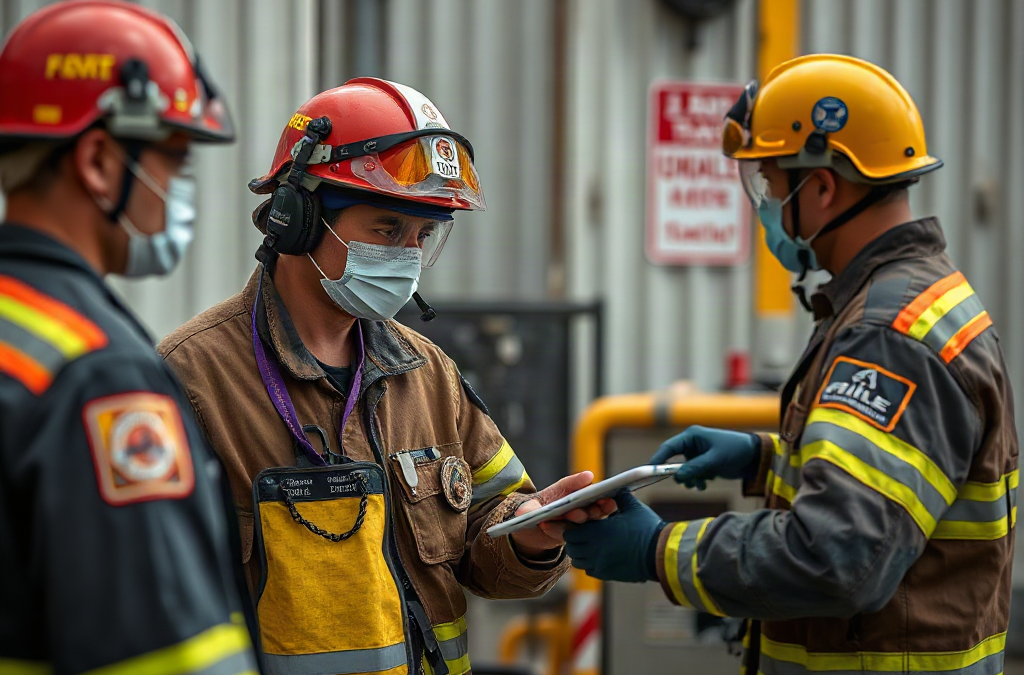
Emergency skills are vulnerable to forgetting because many people use them rarely, under pressure, and with incomplete information. A person may remember that a procedure exists while forgetting the order of actions, the location of supplies, or the point at which outside help is required. Just-in-time instruction addresses that gap by placing a concise reminder close to the moment of use.
Timing does not mean introducing a complex skill for the first time during a crisis. A learner who has never practiced bleeding control, evacuation equipment use, or a communication protocol may not develop reliable performance from a hurried video or card. The safer sequence is foundational instruction during calm conditions, followed by short refreshers when a known risk, shift, event, season, or assignment makes the skill relevant.
Consider a workplace that stores an automated external defibrillator. A nearby visual prompt can remind a trained employee where the device is, how to activate its voice guidance, and how to clear the patient during analysis. It cannot substitute for local emergency activation procedures, formal instruction, or competent medical assessment. The prompt reduces avoidable hesitation without pretending that a reference card turns an untrained person into a specialist.
The main failure is poor timing rather than too little information. A ten-minute lesson delivered weeks before an event may be less useful than a ninety-second rehearsal immediately before a supervised drill. Conversely, a reminder placed where a person cannot safely read it, or delivered while the person is already managing an unstable situation, may create distraction. Training designers should ask whether the learner has enough attention, light, space, and time to use the material.
For a broader foundation, pair this topic with Just-in-time training for emergency skills and procedures as part of a documented readiness program rather than treating it as a standalone solution.
What Effective Just-In-Time Instruction Contains
Useful just-in-time instruction is narrow, visible, and action-oriented. It identifies the immediate task, states the first safe move, shows the required equipment, and explains when the learner must stop or call for help. It avoids lengthy background material when attention is limited. The goal is not to compress an entire course into a handout; it is to make the next authorized action easier to perform correctly.
A strong module usually has four layers: a trigger, a task sequence, a verification step, and an escalation rule. The trigger might be a drill, equipment assignment, weather alert, patient-care scenario, or start of a shift. The sequence should use plain verbs and match the actual equipment. Verification may involve repeating a critical instruction, pointing to a control, or demonstrating a low-risk step. The escalation rule defines what exceeds the learner’s role, available resources, or training.
For example, a shelter team preparing to use a portable generator needs more than a generic “generator safety” reminder. The material should direct the team to the approved operating location, fuel-handling restrictions, ventilation requirements, shutdown procedure, and responsible supervisor. It should not encourage improvisation when the model, site, or local rule differs. A short checklist that matches the device is safer than a polished generic video with unfamiliar controls.
Information density must be managed carefully. Color coding, numbered actions, diagrams, and equipment labels can reduce search time, but clutter can hide the one warning that matters most. Use the same terms on the training card, equipment label, drill script, and reporting form. If one document says “isolate power” and another says “disconnect the source,” learners may hesitate over whether the actions are equivalent.
Common mistakes include presenting warnings without showing the corresponding action, assuming that watching equals competence, and omitting environmental constraints. A procedure may work in a classroom yet fail when gloves reduce dexterity, noise obscures instructions, lighting is poor, or several people speak at once. Test the material in conditions that resemble use while keeping the exercise controlled and safe.
Choosing the Right Format for the Situation
The best format depends on urgency, complexity, risk, and the learner’s prior exposure. A laminated card may be ideal for a short sequence near equipment. A voice-guided application can help when hands are occupied, but it depends on battery power, connectivity, and clear audio. A short video can demonstrate movement or setup, while an instructor-led rehearsal is better when judgment, coordination, or feedback matters.
Do not choose a digital format simply because it is easy to distribute. A phone may be unavailable during a power outage, a login may delay access, and a small screen may make a diagram difficult to interpret. Printed instructions can fail when they are outdated, poorly lit, or stored away from the equipment. A layered approach is often more resilient: a concise physical prompt at the point of use, an offline digital copy, and periodic supervised practice.
Match the format to the error you are trying to prevent. If people cannot find a shutoff, a labeled map may matter more than a lecture. If they confuse the order of actions, a numbered card and coached repetition may help. If they fail to recognize when a situation exceeds their role, scenario discussion and escalation practice are more appropriate than a mnemonic alone.
A community event provides a useful comparison. Volunteers assigned to first-aid support may need a briefing on radio channels, location reporting, supply access, and who contacts professional responders. A detailed clinical manual would be too broad for the assignment. A short role card, a walk-through of the venue, and a radio check would better address the operational risk. Volunteers still need clear boundaries against diagnosing, treating beyond their training, or delaying emergency services.
Review materials after each exercise. If learners repeatedly ask where equipment is located, the problem may be placement rather than instruction. If they perform a step incorrectly despite reading it, the wording or visual design may be inadequate. If they skip the same safety check, the procedure may be too long for the available time or the check may not be integrated into the workflow.
Readers comparing approaches can use Just-in-time training for emergency skills and procedures alongside formal courses, drills, and role-specific competency checks. The short reminder should reinforce the larger system, not become the only exposure to a safety-critical procedure.
Testing Recall, Performance, and Safe Escalation
Emergency training should measure more than whether a learner can repeat information. A person may recite a sequence yet freeze when equipment is unfamiliar or conditions change. Practical checks should examine whether the learner can identify the situation, begin the first authorized action, communicate essential facts, and stop when the scenario requires a higher level of assistance.
Use low-risk scenarios that reflect actual responsibilities. A facilitator might present a blocked exit, a simulated injury, a loss of communication, or a failed piece of equipment. The learner should explain what they notice, what they would do first, and whom they would contact. Where physical practice is appropriate, use safe simulation equipment and clear stop rules. Never create a real hazard to make training feel realistic.
Feedback should be specific and immediate. “Be more confident” does not identify a correctable problem. “You located the kit quickly, but you did not state the incident location before requesting assistance” gives the learner a concrete adjustment. Ask the learner to repeat the missed step rather than assuming that hearing the correction creates lasting recall.
A compact performance check can include:
Identify the hazard and confirm personal safety before intervening.
Locate the correct equipment or communication channel.
Perform the first critical action in the approved sequence.
State the information needed by responders or supervisors.
Recognize the boundary that requires escalation or withdrawal.
Assessment must account for conditions. A perfect classroom demonstration may not predict performance during darkness, crowd noise, protective clothing, or a change in team roles. The answer is not to make every drill extreme. It is to vary one relevant constraint at a time and determine whether the core behavior remains reliable.
A weak assumption is that speed is always the main measure. Rushing can cause skipped safety checks, incorrect equipment selection, or poor communication. Accuracy, hazard recognition, and timely escalation may matter more than shaving seconds from a sequence. Document recurring errors, revise the prompt, and schedule focused practice instead of merely marking attendance.
Building a Sustainable Emergency Training System
Just-in-time training works best when it is maintained like operational equipment. Assign an owner for each procedure, record the approved version, identify the audience, and set a review trigger. Triggers may include equipment replacement, a change in site layout, a revised local protocol, an incident, or a drill that exposes confusion.
Keep a simple priority register. High-risk, low-frequency tasks deserve more frequent prompts and supervised practice than familiar low-consequence actions. Procedures involving electricity, fire, medical care, hazardous materials, or evacuation should be checked against applicable official guidance and organizational requirements. Local emergency services, workplace safety personnel, recognized training organizations, or equipment manufacturers may provide authoritative instructions for specific contexts.
Ownership also prevents stale material. A card that names a retired radio channel or shows a discontinued device can create false confidence. Put a revision date and responsible contact on controlled materials, but do not rely on dates alone. During drills, ask whether the instructions still match the site, staffing, equipment, and authority structure.
Training access should reflect the people expected to act. New staff may require full instruction before receiving a short refresher. Experienced responders may need scenario variations rather than basic definitions. People with disabilities, language needs, or limited digital access may require adapted materials and additional time. Accessibility is an operational issue when a team depends on rapid, shared action.
Organizations should also distinguish readiness from certification. A completion record shows that someone attended or passed a check at a particular time; it does not prove performance in every future situation. Use recurring drills, equipment inspections, after-action reviews, and clear escalation pathways to maintain realistic readiness. The practical measure is whether people can perform the assigned first steps safely and communicate when they cannot proceed.
For planning context, Just-in-time training for emergency skills and procedures should sit beside an inventory of hazards, roles, contact methods, supplies, and formal training requirements. That combination makes short instruction targeted rather than improvised.
Frequently Asked Questions
What does just-in-time emergency training mean?
It is concise, task-specific instruction delivered shortly before or during a relevant assignment. It refreshes or supports known skills rather than replacing foundational training.
Can a quick refresher replace formal emergency training?
No. A refresher may support recall, but complex or safety-critical procedures require appropriate instruction, practice, supervision, and any applicable qualification.
What should an emergency training card include?
Include the first safe action, the correct equipment, the short sequence, critical warnings, communication details, and the point at which the learner must escalate.
How can training effectiveness be checked?
Use a controlled scenario, observe the learner performing the relevant steps, assess communication and hazard recognition, and correct specific errors immediately.
When should just-in-time materials be updated?
Review them after drills, incidents, equipment changes, site changes, staffing changes, or updates to applicable procedures. Remove obsolete copies from every access point.
Further Reading
Authoritative Sources
Ready.gov ready.gov
Offers official preparedness guidance that can help organizations connect short training prompts with broader emergency planning
OSHA Emergency Preparedness osha.gov
Provides workplace-oriented information on emergency planning, response roles, and safety considerations
FEMA Emergency Management Training fema.gov
Lists training resources relevant to emergency management responsibilities and coordinated response
Conclusion
Just-in-time instruction is most valuable when it closes a specific gap between prior learning and immediate action. Build it around the actual equipment, role, environment, and escalation path rather than compressing a full course into a generic reminder. Use short prompts for sequence and recall, coached scenarios for judgment and communication, and formal training for skills that cannot be acquired safely in a crisis. Check whether learners can recognize hazards, perform the first authorized step, and summon appropriate help without creating additional risk. After each drill or incident, revise the material when the evidence shows confusion, outdated equipment, or an impractical workflow. A dependable system combines timely reminders with recurring practice, clear role boundaries, accessible materials, and accountable review.
Preparedness knowledge becomes operational only when a person can recognize a situation, choose a suitable response, and carry it out without relying on lengthy deliberation. Reading about evacuation routes, communication procedures, first aid, or supply storage creates awareness, but awareness does not prove that people can act when an alert arrives during a meal, a commute, a power outage, or a confusing nighttime event. Training must expose the gap between knowing a rule and performing a sequence.
That gap often comes from friction rather than carelessness. A person may know where a fire extinguisher is stored but discover that furniture blocks access. A team may have a contact list but lack a shared definition of “safe” or “ready to leave.” A family may identify two meeting places yet never test how children, pets, mobility limitations, or traffic alter the route. Practice makes those hidden constraints visible before they become urgent.
A useful training sequence separates three abilities: recognition, decision, and execution. Recognition means identifying the signal or condition that requires action. Decision means selecting the appropriate response while information remains incomplete. Execution means completing the response with the available people, equipment, and time. Weak programs teach only recognition through presentations or quizzes. Stronger programs connect each fact to a physical or communicative behavior.
Consider a severe-weather notification. A knowledge-only exercise might ask participants to name the safest room. An action-based exercise asks them to locate that room, bring the required people and supplies, account for pets, and report when everyone is present. The second version may reveal a dead phone battery, an inaccessible doorway, or uncertainty about who monitors alerts. Those discoveries are more valuable than a perfect quiz score because they identify conditions that could delay a response.
Use Preparedness training that converts knowledge into action as a recurring cycle rather than a one-time event. Begin with one high-consequence behavior, define what successful performance looks like, and test it in a low-risk setting. The objective is not to create theatrical stress. It is to remove avoidable confusion while preserving enough realism to expose practical weaknesses.
Designing Drills That Resemble Real Decisions
Effective drills reproduce the decisions and constraints people will actually face, not merely the vocabulary used in a manual. A scenario should specify a starting condition, a limited set of available facts, a decision point, and an observable action. This structure makes training assessable without pretending that every future event will follow a script.
Start with a narrow scenario. For example, an exercise might begin with a text alert, a temporary loss of electricity, and one person away from home. Participants then determine who confirms the message, what information is credible, whether anyone needs assistance, and how they communicate their status. The exercise can remain simple while still testing priorities, role clarity, and information discipline. Adding several hazards at once often creates spectacle rather than useful learning.
Scenario design should reflect the difference between normal capacity and disrupted capacity. A route that works with bright daylight may be unsuitable during smoke, darkness, flooding, or heavy traffic. A communication plan that depends on one app may fail when devices lose power or networks become congested. A supply list may appear complete until someone must retrieve it quickly while carrying a child or assisting an injured person.
One practical progression moves from demonstration to guided rehearsal, then to an unannounced knowledge check or timed exercise. Demonstration gives participants a clear model. Guided rehearsal allows questions and correction. The later test shows whether the behavior survived without prompts. Beginners may need visible checklists and coaching; experienced participants may benefit more from changing one condition, such as removing a preferred communication channel or introducing an unavailable team member.
Realism requires judgment. A drill that is too gentle may hide failures, while a surprise exercise that creates fear can damage trust and produce unsafe behavior. Tell participants the boundaries, protect anyone with medical or accessibility concerns, and avoid actions that imitate danger in ways that could trigger emergency services or cause injury. Training should challenge decisions, not reward panic.
After each exercise, ask what participants noticed first, which decision took longest, what information was missing, and which step depended on an assumption. A useful debrief connects observations to changes: move an item, revise a message, assign a backup, shorten a checklist, or schedule a repeat test. Without that conversion, a drill becomes an isolated event rather than a mechanism for improvement.
Feedback, Measurement, and Skill Retention
Feedback turns activity into learning when it describes the behavior, its consequence, and the next adjustment. “Good job” may encourage participation but does not tell a learner whether the response was complete. A more useful observation is, “The alert was acknowledged quickly, but no one confirmed the location of the person who was away.” That wording identifies a successful element and a specific gap without assigning blame.
Measure actions that matter. Depending on the exercise, useful indicators may include time to acknowledge an alert, accuracy of the location decision, completion of an accountability check, correct use of equipment, clarity of the status message, or the number of prompts required. These measures should be modest and observable. A complicated scoring system can consume attention that belongs on the response itself.
Quality matters more than speed alone. Rushing through a checklist while skipping a dependent person or misreading an instruction is not strong performance. Compare speed with accuracy, safety, communication, and completeness. For a team, also examine whether information moved to the person who had authority to decide. A fast action based on an unverified rumor may create greater risk than a short pause to confirm the source.
Retention depends on revisiting skills at useful intervals and varying the context enough to prevent memorized choreography. If every drill uses the same starting point, participants may learn the exercise rather than the capability. Change the time of day, the available communication method, the meeting location, or the role assignment while keeping the core objective stable. The changes should be deliberate, not arbitrary.
Suppose a group repeatedly fails to report status after reaching a meeting point. The solution may not be another lecture about communication. A better response could be a short exercise in which each person sends a defined message using two available channels, followed by a check of contact ownership and backup power. If the behavior improves only when an instructor prompts it, the design has not yet produced independent performance.
Use a simple record after each session: objective, observed result, cause of difficulty, correction, and date for retesting. This record supports the training process without turning preparation into paperwork. Repeated failures deserve priority over minor imperfections, especially when they affect life safety, accountability, or access to essential information.
Building a Training Cycle That Works Under Constraints
A sustainable program fits the time, space, budget, and attention available to its participants. A two-hour annual session may look efficient, but long gaps allow procedures, contact details, and equipment locations to become stale. Short practice periods distributed across the year often expose changes sooner and place less strain on work, school, or family schedules.
Build each cycle around one outcome. A monthly session might test alert acknowledgment, route selection, communications, equipment retrieval, or reunification. The next session can connect two skills only after each works independently. This sequence limits cognitive overload and makes failure easier to diagnose. If every activity combines evacuation, medical care, logistics, and communications, participants may finish tired without knowing which component needs correction.
Assign ownership for maintenance as well as performance. Someone should verify that contact information remains current, batteries are usable, access paths are clear, instructions match the location, and substitutes understand their role. A plan that lives only in one person’s memory is fragile. At least one backup should know where the relevant information is stored and what decision they can make without waiting for permission.
Constraints should shape the exercise rather than be treated as excuses. A small household can rehearse a notification and accountability check in ten minutes. A workplace may use a tabletop discussion before attempting a movement drill. A volunteer group with limited equipment can practice information flow and role transfer without simulating hazards. The method changes, but the test remains concrete: what happens, who acts, what is communicated, and how success is recognized.
Use this compact priority order when time is limited:
Protect people first: identify immediate hazards and unsafe actions.
Confirm status: determine who is present, missing, injured, or unable to follow the standard route.
Communicate a shared picture: send concise, verified information through an agreed channel.
Review the constraint: note what equipment, access, staffing, or information failed.
Retest the weak step: schedule a focused repeat rather than waiting for the next annual review.
Training is working when participants need fewer prompts, identify problems earlier, and adapt safely when one expected resource is unavailable. It is failing when people can recite procedures but hesitate at the first decision point, rely on one individual, or treat a completed drill as proof that the underlying system is sound.
Common Training Mistakes and Better Alternatives
The most common mistake is equating attendance with readiness. A person can sit through a polished presentation and still be unable to find the exit, send the required message, or explain who takes responsibility for a dependent. Replace attendance as the main measure with a small demonstration of the behavior the training is meant to produce.
Another failure is designing around ideal conditions. Instructions may assume every person has a charged phone, understands the same language, can use stairs, or is available at the planned location. Review the exercise from the perspective of someone arriving late, working remotely, caring for a child, using mobility equipment, or lacking access to the preferred communication channel. Inclusive planning is not an extra topic; it changes whether the response is usable.
Overloading participants with supplies can create a false sense of readiness. Equipment has value only when people know where it is, can access it, understand its limits, and can maintain it. Compare a large untested kit with a smaller set of familiar items that are checked and assigned. The second option may be more dependable when time and storage are limited.
Training also suffers when leaders avoid uncomfortable findings. If a drill reveals that no one can confirm a missing person, recording a pass because the route was completed hides the central risk. Debriefs should distinguish between a flawed action and a flawed system. The remedy may involve clearer authority, better labeling, an alternate route, or a change to the plan rather than more effort from the same person.
Ultimately, do not confuse realism with escalation. Loud alarms, surprise, or simulated injuries are not automatically educational. Use the least disruptive method that tests the target behavior, protect participants from unnecessary distress, and stop an exercise when conditions become unsafe. The most useful training design produces honest information about performance while preserving trust for the next session.
For additional planning detail, consult current guidance from local emergency-management agencies, public-safety organizations, and recognized first-aid or workplace-safety providers. These sources can help align drills with local hazards, accessibility needs, communication options, and official procedures without replacing hands-on practice.
Frequently Asked Questions
What makes preparedness training action-oriented?
It requires participants to perform a defined behavior, such as confirming an alert, selecting a route, sending a status message, or retrieving equipment, and then reviews the result.
How often should preparedness drills be repeated?
Repeat important skills often enough to catch changes in people, routes, equipment, and contact information. Short periodic sessions are usually easier to maintain than one lengthy annual event.
Should drills be announced in advance?
Use announced practice when teaching a new skill or protecting participant safety. Once the basics are reliable, a limited knowledge check can test independent performance without creating unnecessary fear or confusion.
What should be measured during a drill?
Measure observable factors such as decision accuracy, completion, communication clarity, accountability, safety, time, and the number of prompts needed.
What if a group has very little time or equipment?
Choose one high-priority behavior and test it with available resources. A brief communication or accountability exercise can reveal major weaknesses without requiring a full-scale simulation.
Conclusion
Preparedness improves when training treats action as the evidence of learning. Choose a specific behavior, rehearse it under realistic but controlled constraints, observe what actually happens, and correct the system rather than blaming the participant. Give priority to life safety, accountability, communication, and access to essential equipment before adding complexity. A practical drill may reveal that a route is blocked, a message is ambiguous, or a responsibility has no backup; those findings are progress because they can be fixed before an urgent event. Record the correction and retest the weak step. Knowledge remains useful, but repeated performance is what makes a response more dependable when time, information, and attention are limited.
Effective household preparedness begins with an honest picture of how the household functions on an ordinary day. A family may need to manage a power outage, severe weather, temporary water interruption, evacuation order, illness, or loss of transportation. Each situation creates different pressures, so a useful plan connects hazards to people, routines, and decisions rather than simply collecting supplies.
Start by listing who may need assistance and what that assistance involves. A toddler may need familiar food and a comfort item; an older adult may rely on refrigerated medication, mobility equipment, or a precise daily schedule. A person with sensory, cognitive, or communication needs may require visual instructions, noise reduction, or extra time. Pets, service animals, and livestock also belong in the household assessment because leaving them out can delay evacuation or split the family.
A simple risk-and-needs discussion can produce better priorities than a generic checklist. Ask what would happen if the household could not use electricity for a day, could not reach a usual caregiver, or had to leave within minutes. Note which tasks are time-sensitive, which supplies have expiration dates, and which decisions require outside help. The goal is not to predict every event; it is to reduce avoidable uncertainty.
For example, a family that normally depends on one parent for school pickup should identify a backup adult, confirm authorization requirements, and store contact details offline. A family in an apartment may prioritize stair access, hallway lighting, and a reunification location outside the building, while a rural household may need to account for longer travel distances and limited communications.
Do not confuse a large stockpile with coping capacity. Supplies that nobody can find, understand, or safely use add little value. Begin with the needs most likely to create immediate danger or separation, then expand gradually. The related household preparedness for enhanced family coping process becomes more reliable when every item has a reason, a location, and a person responsible for checking it.
Assign Responsibilities That Work Under Stress
Responsibilities improve family coping when they are specific, shared, and matched to ability. A plan that says “someone will handle communication” leaves too much ambiguity. A stronger version names the primary task, the backup person, the required tools, and the point at which the task begins.
Useful assignments might include collecting children, checking on a neighbor who has agreed to assistance, turning off a utility when safe and appropriate, carrying the document pouch, monitoring official alerts, or accounting for pets. Assignments should not depend on a single highly capable adult. If that person is away, injured, overwhelmed, or unable to access the home, the plan needs another workable path.
Stress changes attention and memory. People may miss instructions, repeat tasks, or freeze when choices are unclear. Short written prompts can reduce that burden. A card near the emergency supplies might state where the flashlight is, who calls the out-of-area contact, and where the household meets if mobile service fails. Children can have age-appropriate jobs such as bringing a small comfort bag or checking that a sibling has shoes, but they should not be made responsible for safety-critical decisions.
Practice should resemble the household’s actual constraints. A family with a baby can rehearse moving with a stroller and diaper bag; a household with a wheelchair user can identify accessible exits and transportation alternatives. A teenager who spends afternoons away from home may need a separate route, permission details, and a backup contact rather than instructions designed for someone already inside the house.
A common failure is assigning tasks by habit instead of capability. The person who usually manages paperwork may not be the person who can quickly evacuate with a pet or navigate during a power failure. Compare the ideal arrangement with the difficult-day arrangement: who is present, who has a charged phone, who knows the location of supplies, and who can make a decision if contact is lost? Document both primary and backup roles, then rotate practice so the plan does not remain invisible knowledge held by one person.
Prepare Supplies, Information, and Communication Backups
Household supplies should support continuity, not merely survival in the abstract. Prioritize items that protect hydration, medication access, safe food, light, communication, hygiene, and mobility. Store them where household members can reach them without moving heavy objects or entering an unsafe area.
A practical setup often includes drinking water, shelf-stable foods that the family already eats, a manual can opener, prescription information, first-aid materials, flashlights, spare batteries, chargers or power banks, sanitation supplies, copies of key documents, cash in suitable denominations, and supplies for infants, older adults, pets, or medical equipment. Food should reflect dietary restrictions and preparation limits. A box of dry goods is less useful if it requires cooking during a power outage or causes an avoidable allergy problem.
Communication planning deserves equal attention. Write down phone numbers, addresses, school contacts, medical contacts, and an out-of-area contact on paper. Decide how family members will confirm safety and where they will reunite if normal routes fail. Official alerts may arrive through more than one channel, but no household should assume that internet access, mobile service, or a television will always work.
Organize supplies by use rather than by product category. A rapid-exit bag might contain identification copies, medications, water, snacks, a charger, a small light, and comfort items. A home-stay container might hold sanitation materials, batteries, cooking alternatives, and extra food. Label both clearly and check whether a child, older adult, or visitor could understand the labels.
Storage has tradeoffs. A locked cabinet may protect medication or documents but slow access; an outdoor container may be convenient but expose supplies to temperature and moisture. Keep critical items in more than one sensible location when loss of the primary area is plausible. Replace expired medications and batteries according to their instructions, rotate food through normal meals, and test chargers rather than assuming they work. The family coping plan should explain how supplies are used, because possession without familiarity can create delay at the moment they matter.
Practice, Review, and Strengthen Recovery
Practice turns a written household plan into shared behavior. It does not need to be dramatic or exhausting. A ten-minute exercise can test whether everyone knows the meeting place, can locate a flashlight, and understands who contacts an absent family member. A second exercise can test a different constraint, such as no internet access or a blocked front entrance.
After each practice, ask what actually happened. Did someone forget a key, misunderstand a phrase, or discover that a bag was too heavy? Did a child become distressed by the alarm sound? Did an adult assume another person had called the school? These observations are more useful than declaring the drill successful. A plan is working when household members can explain their next step, find what they need, and identify an alternative when the first option fails.
Emotional coping belongs in the exercise. Calm, plain language is more effective than promises that nothing bad will happen. Children often cope better when adults explain what is known, what is being done, and what the child can do next. Familiar books, headphones, comfort objects, prescribed medications, and predictable routines may reduce distress, but they do not replace adult supervision or professional care when severe reactions persist.
Recovery planning also deserves attention. After a disruption, the household may need to document damage, replace medication, restore charging, arrange temporary housing, contact schools, or check on relatives. Keep important records protected and make a short list of agencies, insurers, utilities, schools, and medical offices that may need contact. Avoid discarding damaged items before checking whether documentation is needed, while also following safety guidance for contaminated or dangerous materials.
Review the plan after a move, new diagnosis, birth, death, change in work schedule, new pet, or change in transportation. At least one annual review can expose expired contact details and supplies, but major household changes should prompt an immediate update. Use the preparedness review to remove plans that no longer fit rather than adding complexity. A shorter plan that people remember is often more useful than a detailed binder nobody opens.
Frequently Asked Questions
What should a household prepare first?
Begin with medication access, drinking water, food that needs little preparation, light, communication, and a way to account for every person and pet.
How can children participate safely?
Give children simple, practiced tasks such as carrying a comfort item or checking a buddy, while adults retain responsibility for evacuation, medical care, and critical decisions.
How often should a family review its plan?
Review it at least annually and whenever the household changes, including a move, new medication, new caregiver, altered work schedule, or new pet.
What if family members are separated?
Use a written contact list, an out-of-area contact, predetermined meeting places, and separate instructions for school, work, and home locations.
Does preparedness require expensive equipment?
No. Clear roles, paper contact information, familiar foods, working flashlights, medication details, and practiced communication often provide more value than specialized equipment.
Further Reading
Authoritative Sources
Family Emergency Plan ready.gov
Provides federal planning prompts for contacts, meeting places, alerts, and household-specific needs
Make a Plan redcross.org
Offers practical planning guidance for communication, evacuation, and family assistance needs
Build an Emergency Kit ready.gov
Helps households evaluate supplies for sheltering, communication, sanitation, and individual requirements
Conclusion
Enhanced family coping comes from reducing uncertainty before a disruption occurs. Map the household’s real needs, assign primary and backup responsibilities, keep essential supplies accessible, and write down communication and reunification details. Then test the plan in short, realistic exercises that expose problems with mobility, caregiving, technology, food preparation, or emotional stress. Correct one or two failures at a time instead of building an unwieldy system. Recheck medications, contacts, food, chargers, documents, and pet arrangements after meaningful household changes. The next useful step is a brief family meeting: identify the most likely disruption, choose one meeting place, assign one backup contact, and verify that every person can find the supplies needed for the first day.