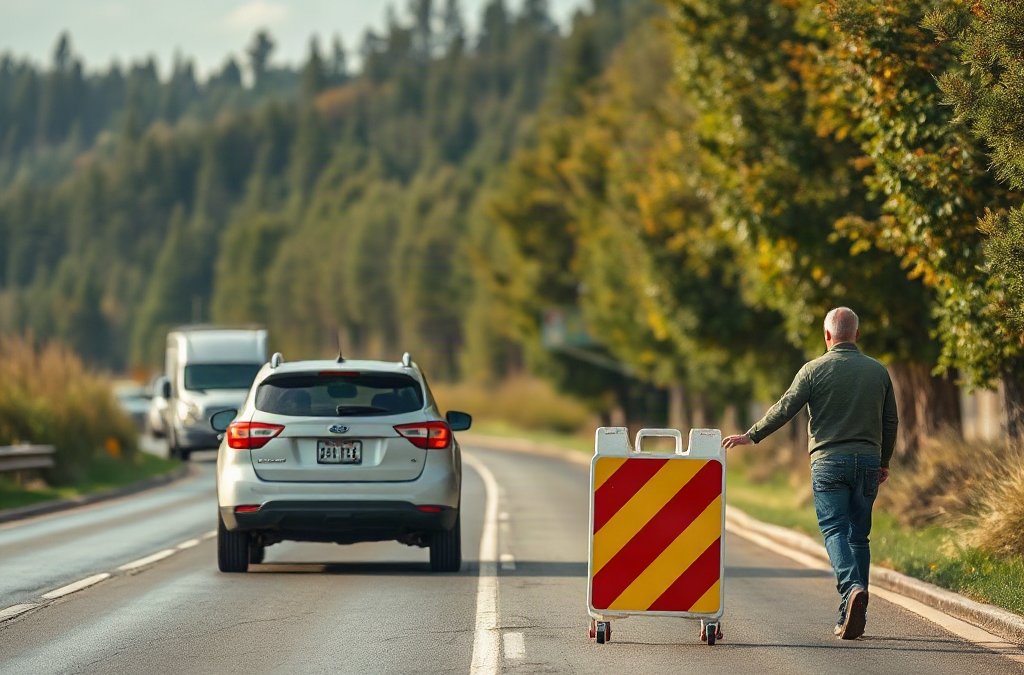
A route has failed when it no longer provides a reasonably safe and usable path to the intended destination. A fallen tree, bridge closure, rising water, wildfire smoke, collision, police activity, gridlocked traffic, or loss of road access can all turn a familiar route into a trap. The plan should describe these conditions in plain language rather than relying on a vague instruction to “find another way.”
Separate route failure from ordinary delay. A slow road may still be usable if vehicles can move, fuel is available, and emergency access remains open. A blocked road, rapidly changing hazard, or official direction to leave the area requires a different response. Waiting beside a closure can expose people to smoke, floodwater, falling debris, or traffic moving unpredictably. The first decision should be whether to turn around, use the nearest signed detour, shelter temporarily, or proceed to a different destination.
Write down the assumptions behind the decision. Can every vehicle turn around? Is the route suitable for a trailer, wheelchair, or vehicle with limited fuel? Does the destination remain safe if the hazard expands? A route that works for a small car may be unsuitable for a large vehicle or a person needing accessible facilities. A family may also need separate arrangements for pets, children, medication, or mobility equipment.
Use a simple hierarchy: life safety first, official instructions second, route convenience third. Do not choose a shorter road that crosses moving water or enters a visibly affected area merely because it avoids congestion. The Contingency plan for a failed evacuation route should name a primary destination, at least one nearer fallback, and a condition that makes each option unsuitable.
Build Alternate Routes That Work
An alternate route is useful only if it has been checked against the same hazard that defeated the primary route. Map two or three options from important starting points, not just from the home. Include a route from work, school, or a regular medical appointment if household members may evacuate separately. Mark major junctions, bridges, dead-end roads, fuel stations, public facilities, and places where a vehicle can safely turn around.
Do not assume that a minor road is automatically safer. Narrow roads may become impassable when residents leave at once, and rural routes may have limited lighting, fuel, shoulders, or reception. A route through a low area may be a poor substitute during flooding; a wooded shortcut may be unsuitable during wildfire conditions; and a road near the original hazard may become blocked without warning. Compare alternatives by hazard exposure, road width, traffic direction, fuel demand, and the ability to reverse course.
A practical route record can fit on one printed page. For each option, note the starting point, first turn, major decision points, destination, known restrictions, and the reason it may fail. Keep a paper map with the marked routes in each vehicle because a phone may lose power, data service, or accurate location information. Digital maps remain useful for traffic and closures, but they should support—not replace—local knowledge and official messages.
Consider a household leaving during a fast-moving fire. The primary route is closed at a junction, while the navigation app continues to display it because the closure has not reached the mapping service. A preselected secondary road may still be open, but only if it leads away from the smoke and does not depend on the same downstream bridge. If both routes converge later, they are not truly independent alternatives. That shared point is a failure dependency and should be treated as another decision point.
Test the route at the time and with the equipment likely to be used. A daylight drive may not reveal poor visibility, school-zone congestion, steep grades, or a gate that is closed overnight. Testing does not guarantee availability, so record conditions rather than treating the route as permanent. Update the map after construction, seasonal closures, or changes to household vehicles.
Set Triggers, Decision Points, and Communications
Clear triggers prevent indecision at the moment the primary route becomes unusable. A trigger might be an official closure, water reaching the roadway, visible smoke reducing safe visibility, emergency personnel directing traffic elsewhere, or a complete standstill at a known choke point. The trigger should identify the next action: take Route B, move to a nearby holding location, or abandon the destination and use Route C.
Give every traveler the same decision points. For example, the instruction might be: “If Junction Oak is closed, do not continue toward the bridge; turn toward the library and reassess at the marked intersection.” A named landmark is easier to recognize than a street number, especially in darkness or stress. Decide in advance who can change the plan. A driver must be able to respond to immediate danger, while a designated contact can help coordinate people who are traveling separately.
Communication should work through several channels. Use local emergency alerts, official websites or radio broadcasts, and direct calls or text messages when networks function. A short message is more useful than a long explanation: state the person’s location, route status, next destination, and whether assistance is needed. Establish a check-in schedule only when it does not distract the driver. Never require someone to keep calling while operating a vehicle.
Choose a meeting arrangement that does not depend on one exact road. A primary meeting point can be paired with a secondary point in another direction. If family members cannot reach either location, they should know which out-of-area contact will receive updates. The contact should not make tactical decisions without current information; their role is to relay messages and reduce conflicting reports.
Common communication failures come from assumptions: everyone has a charged phone, everyone knows the destination, or a message sent means it was received. Keep a car charger or battery pack where it can be reached safely, but do not depend on electronics alone. A printed contact card, paper map, and written route codes provide a low-technology fallback. Reassess the plan when official instructions conflict with a household preference; official evacuation directions take priority over a privately chosen shortcut.
Practice the Plan Under Real Constraints
Practice should test decisions, not merely prove that someone can recite street names. Run a tabletop scenario in which the primary exit is blocked, then ask each person what they would do, where they would turn, and how they would report their status. Follow with a short drive on the alternate route when conditions are safe. The exercise may reveal that a child cannot identify the meeting place, a pet carrier is inaccessible, or the printed map is stored in a locked compartment.
Assign practical roles without making the system dependent on one person. One adult may drive, another may check official information, and an older child may carry the contact card. Anyone traveling alone needs a simpler version: route cards, a fallback destination, and a clear rule for stopping safely before making a call. People with mobility limitations may need additional time, an accessible vehicle, or a route that avoids stairs and uneven surfaces. Pets require carriers, leashes, and destination confirmation because not every shelter or lodging option accepts animals.
A compact pre-departure check should confirm:
phones, chargers, identification, medication, and essential mobility items;
fuel level, tire condition, lights, and room for all passengers;
paper maps with primary and alternate routes marked;
pet restraints, child seats, water, and weather-appropriate clothing;
the current destination, meeting point, and communication contact.
The checklist is not a substitute for judgment. If smoke is thickening, floodwater is moving across the road, or officials are redirecting traffic, abandon the exercise’s planned sequence and follow immediate safety instructions. A route is failing when progress requires risky improvisation, repeated reversals, or entry into a visibly worsening hazard. That is a sign to use the next fallback, not to preserve the original itinerary.
Review the plan after every drill or real evacuation. Record where the route became confusing, which messages arrived late, and whether the destination had capacity. A shorter route is not necessarily a better route if it lacks room to turn around or shares the same vulnerable bridge. The best revision may be less convenient but more robust: an earlier departure trigger, a farther meeting point, or a destination outside the original hazard zone.
For route-specific decisions, consult local emergency-management offices, transportation departments, fire agencies, and official alert systems. Their closure notices and evacuation instructions are more reliable than crowdsourced map comments during a fast-changing incident.
Frequently Asked Questions
How many alternate evacuation routes should a household have?
Identify at least two alternatives when geography allows, then check whether they share bridges, tunnels, low points, or the same final junction. Shared dependencies reduce the value of having several lines on a map.
When should someone abandon the primary evacuation route?
Change course when officials close it, the hazard reaches the roadway, visibility becomes unsafe, traffic cannot move, or continuing would require entering a restricted area. Do not wait beside a confirmed blockage for conditions to improve.
Are phone navigation apps enough for evacuation planning?
No. Apps can lack current closure data or fail when power and networks are limited. Pair them with a paper map, predriven routes, official alerts, and written decision points.
What should a family do if members are separated when a route fails?
Use the agreed destination hierarchy and send brief status messages when safe. A designated out-of-area contact can relay information, while each traveler follows the route and meeting rules rather than chasing uncertain updates.
How often should an evacuation contingency plan be reviewed?
Review it after route construction, household changes, vehicle changes, seasonal hazards, or any drill. A short annual drive and tabletop exercise can expose assumptions that a written plan hides.
Conclusion
A failed evacuation route demands a prepared decision, not improvised navigation at a dangerous roadblock. Build alternatives that do not share the same vulnerable crossing, mark recognizable decision points, and pair digital information with paper maps and written contacts. Set clear triggers for changing direction, but leave room to follow official instructions when conditions move faster than the plan. Test the routes with the actual vehicles, passengers, pets, and accessibility needs involved. Afterward, correct confusing turns, weak communications, and destinations that cannot accommodate the group. The next practical step is to mark one primary route and two independent fallbacks, then explain the sequence to everyone who may have to travel without the household’s usual coordinator.
A week-long utility outage should be treated as a temporary loss of several systems at once, not merely a power failure. Electricity may stop refrigeration, water pumping, heating, cooling, internet access, card payments, and some medical equipment. The first useful step is to count the people, pets, and services that depend on your home, then build supplies around those actual needs.
Water deserves the earliest attention because people can reduce food variety more easily than they can reduce drinking and sanitation needs. Include drinking, cooking, hand cleaning, tooth brushing, and medication use in the calculation. Store commercially packaged water where possible, and add containers for collecting or transferring water without opening every stored bottle. If anyone takes daily medication, uses formula, relies on mobility equipment, or needs refrigerated treatment, that requirement changes the baseline.
A small apartment and a detached home face different constraints. An apartment resident may have limited storage and may be unable to use a balcony grill or fuel-burning appliance safely. A homeowner may have more room for water and a generator but also more responsibility for sump pumps, well systems, septic equipment, and frozen pipes. The right approach is not the largest possible stockpile; it is a workable reserve that fits the dwelling and can be used safely.
Write the baseline on paper rather than trusting memory. Include:
People, pets, infants, older adults, and anyone with medical or dietary requirements.
Drinking and sanitation water, including a separate reserve for pets.
Food requiring little or no cooking, plus a manual can opener.
Prescription medicines, first-aid items, hygiene products, and essential documents.
Lighting, charging, weather-appropriate clothing, and a way to receive official updates.
A common failure is buying supplies without checking whether they work together. Dry food is less useful if it requires boiling water, and a generator is not a complete solution if fuel storage, ventilation, extension cords, or appliance loads have not been considered. Test the equipment before an outage and record expiration dates. The week-long utility outage preparation process becomes manageable when every item has a defined purpose, storage location, and safe operating method.
Protect Water and Food When Refrigeration Stops
Food and water decisions become more difficult after the refrigerator warms, so separate supplies into three groups: items used immediately, foods that remain safe at room temperature, and foods that should be discarded if temperature control is uncertain. Keep refrigerator and freezer doors closed as much as possible. A thermometer placed in the refrigerator and freezer gives better information than smell or appearance, which cannot reliably confirm safety.
Choose foods according to preparation limits rather than marketing labels. Ready-to-eat canned beans, fish, vegetables, fruit, nut butter, crackers, shelf-stable milk, dried fruit, and individually packaged meals can cover different textures and nutritional needs. Include foods that require little water and no heating. A family that stores only dehydrated meals may discover that its water reserve is consumed quickly, while a household with only canned food may lack a way to open or serve it.
Use a normal-food-first rotation. Keep newer items behind foods already in the pantry, and mark unusual preparation requirements on the package or storage bin. During an outage, eat refrigerated perishables first only if they remain within safe temperature limits; do not gamble on meat, dairy, leftovers, or cut produce after prolonged warming. Frozen food that still contains ice crystals may sometimes be moved or cooked promptly, but uncertain items should not be rescued merely to avoid waste.
Water storage needs protection from heat, chemicals, pests, and freezing. Use containers intended for potable water, keep them off the floor when practical, and follow the container maker’s replacement or treatment instructions. Do not assume water from a swimming pool, decorative pond, water heater, or rain barrel is ready to drink. Water from an unverified source may require treatment appropriate to the contaminant, and some treatment methods do not remove chemicals or fuel.
Cooking equipment creates a major tradeoff. An indoor electric hot plate is useless without electricity, while a camp stove may create fire and carbon monoxide hazards indoors. If cooking outdoors is permitted and conditions are safe, use equipment exactly as labeled and keep it away from doors, windows, and combustible materials. Otherwise, make no-cook foods the foundation and regard heated meals as optional. A weak assumption is that a full pantry equals a usable pantry; the practical test is whether every person can eat safely when refrigeration, water pressure, and cooking power are unavailable.
Keep Light, Communication, and Charging Available
Lighting should be distributed, not stored as one powerful flashlight that nobody can find. Place a flashlight or lantern near sleeping areas, the kitchen, the main exit, and the electrical panel. Headlamps are useful when both hands are needed for carrying water or checking a breaker. LED lights generally provide efficient illumination, but their batteries still need testing and rotation.
Communication equipment matters because utility restoration times can change and local hazards may develop. Keep a battery-powered or hand-crank radio, spare batteries in their original packaging, a written list of utility contacts, and a paper record of key phone numbers. A charged phone is valuable, but a phone alone is fragile: cellular networks may become congested, charging may be unavailable, and stored numbers may be inaccessible if the device fails.
Power banks should be charged before severe weather or planned maintenance, then reserved for high-value uses such as emergency calls, medical devices, or official alerts. Avoid spending the first evening streaming video or repeatedly checking social media. If a vehicle is used to charge equipment, operate it outdoors in an open area and never inside a garage, even with the door open.
Backup generation requires a load decision before purchase. List the appliances that truly need power, such as a medically necessary device, refrigerator, well pump, or sump pump, then determine their starting and running requirements from manufacturer documentation. A smaller battery station may quietly charge phones and lights but may not run a heating appliance. A fuel generator may handle larger loads but introduces carbon monoxide, fire, fuel storage, noise, and maintenance concerns. Neither option replaces insulation, warm clothing, water, or a communication method.
Test the complete setup rather than individual components. Connect the intended cable, locate the adapter, check whether the battery holds charge, and confirm that the device accepts the available output. Common failures include incompatible connectors, dead batteries, tripped breakers, overloaded power strips, and extension cords used for loads they cannot safely carry. Clear labeling and a short written procedure reduce mistakes when the home is dark or someone is tired.
Manage Sanitation, Temperature, and Safety
Sanitation becomes a utility problem when toilets cannot flush, water pressure drops, or wastewater systems stop operating. Store liquid hand soap, hand sanitizer, toilet paper, absorbent materials, heavy-duty bags, disinfecting supplies, and personal hygiene products. Keep sanitation supplies separate from food and water so a leaking cleaner cannot contaminate the reserve.
Before an outage, learn whether the home uses a municipal sewer, septic system, private well, or pump-dependent plumbing. Do not repeatedly flush a toilet when the system may not have water or power to move waste. A temporary waste arrangement may be necessary, but it must be kept away from food preparation, sealed appropriately, and handled according to local public-health instructions. Never mix bleach with ammonia, acids, or other cleaners; dangerous gases can form.
Temperature control depends on the season and the occupants. In cold weather, close off unused rooms, block drafts, dress in layers, and protect plumbing that may freeze. Never heat a home with an oven, charcoal grill, outdoor heater, or generator. In hot weather, use shades during the day, ventilate when outdoor conditions permit, drink regularly, and check on people who are sensitive to heat. Fans may improve comfort but do not make dangerously hot indoor conditions safe by themselves.
Households with oxygen equipment, powered beds, refrigerated medicines, dialysis needs, or other electrically dependent care should contact the equipment provider and health-care team before an outage. A generic battery backup may not be approved for specialized equipment. The best alternative may be relocation to a designated support site rather than attempting to operate every device at home.
Security and fire prevention also change. Unplug sensitive electronics when power is unstable, leave one light switched on so restoration is noticeable, and keep candles out of the routine when battery lighting is available. A frequent mistake is treating a generator as an indoor appliance or placing it near a window for convenience. Carbon monoxide has no reliable warning odor, so outdoor placement and an operating carbon monoxide alarm are non-negotiable safety measures.
Use a Practical Outage Routine
A seven-day reserve works better when supplies are organized into daily-use bins instead of buried in a closet. Put the first-night items together: lights, chargers, water, ready-to-eat food, medications, hygiene supplies, and a radio. Keep a second set of essential items accessible if the outage begins while someone is away from home. Store heavier water containers where they can be lifted safely; an emergency supply that cannot be moved is an avoidable hazard.
When the outage begins, check immediate safety before inventory. Look for downed lines, gas odors, flooding, extreme indoor temperatures, and anyone who depends on powered medical equipment. Report the outage through the utility’s official channel, but do not assume an estimated restoration time is firm. Turn off or unplug selected appliances, leave one lamp on, and avoid opening the refrigerator unnecessarily.
Use a simple daily rhythm: inspect water and temperature needs in the morning, prepare food before darkness, recharge priority devices during the best available window, and check sanitation supplies before they run low. Keep a written consumption record. If water use is higher than expected, change handwashing methods, reduce dishwashing, and move to foods with fewer preparation demands rather than discovering the shortage on the final day.
After power returns, restoration is not the same as immediate normal operation. Check appliances before reconnecting everything, verify that refrigerated food remained safe, and inspect the home for leaks, electrical damage, spoiled food, or frozen pipes. Replenish used supplies while the experience is fresh. The outage readiness checklist should reflect what actually ran out, what failed, and what was never needed.
A useful rehearsal is a short evening without normal utilities. Switch off selected conveniences, use the intended lights, prepare a no-cook meal, locate water, and practice the communication process. This reveals hidden problems such as inaccessible storage, insufficient lighting, missing adapters, or food nobody will eat. The goal is not to imitate hardship; it is to expose preventable friction before a real outage lasts a full week.
Frequently Asked Questions
How much water should be stored for a week-long outage?
Use your household’s drinking, cooking, medication, and sanitation needs as the baseline, then add a separate amount for pets and special care. Official local guidance should take priority where available.
What foods work best when the power is off?
Choose ready-to-eat canned foods, nut butter, crackers, fruit, vegetables, shelf-stable milk, and other items that need little water and no refrigeration. Include a manual opener.
Can a generator run inside a garage with the door open?
No. Generators must be operated outdoors, away from doors, windows, and vents. An open garage does not reliably prevent carbon monoxide from entering the home.
How can food be kept cold during an outage?
Keep refrigerator and freezer doors closed, use appliance thermometers, and follow food-safety guidance when deciding what to keep. Do not rely on smell or appearance alone.
What should households with medical equipment do?
Ask the equipment provider and health-care team about approved batteries, backup power, and relocation options before an outage. Do not assume a consumer power station is compatible.
Further Reading
Authoritative Sources
Power Outages ready.gov
Provides federal emergency guidance on outage hazards, planning, medical needs, and generator safety
Food Safety During a Power Outage cdc.gov
Explains how to handle refrigerated and frozen food when electricity is unavailable
Emergency Disinfection of Drinking Water epa.gov
Describes recognized methods and limitations for treating drinking water during an emergency
Carbon Monoxide Safety cpsc.gov
Offers consumer safety information about generators, fuel-burning appliances, and carbon monoxide exposure
Conclusion
Readiness for a week without utilities depends on matching supplies to the home’s real vulnerabilities. Secure drinking water first, then choose food that remains usable without refrigeration or indoor fuel-burning cooking. Add distributed lighting, charged communication devices, medications, sanitation materials, and season-appropriate ways to stay safe. Treat generators and stoves as specialized equipment with strict placement and ventilation requirements, not as casual indoor conveniences. A short rehearsal can expose missing adapters, inaccessible storage, unrealistic meal assumptions, and excessive water use. After the outage, inspect food, plumbing, appliances, and supplies before returning to normal. Make the next step concrete: count household needs, assemble a first-night container, test every powered device, and replace anything consumed or expired.
Household preparedness works best when it reflects disruptions that are plausible where you live and difficult for your household to manage. A winter storm may create a heating and travel problem, while a summer outage may create a cooling, medication-storage, and food-safety problem. A plumbing failure can affect sanitation without interrupting electricity. Treating all hazards as identical produces an expensive pile of equipment that may not solve the first problem you actually face.
Begin with a short risk review. Consider the hazards identified by your local emergency management office, the age and mobility of household members, medical dependencies, pets, building type, evacuation routes, and how long a repair or service interruption could reasonably affect you. An apartment resident may need compact water storage, stair lighting, and a communication plan rather than fuel-heavy tools. Someone in a rural home may need more water, vehicle capability, and a longer bridge to outside services.
Rank risks by likely disruption and consequence, not by how dramatic they sound. A useful first tier often includes loss of electricity, unsafe or unavailable tap water, severe weather, fire, illness, and temporary inability to shop. The ranking should change with location: wildfire smoke may make air filtration more relevant than flood barriers, while flood-prone homes need higher storage placement and an evacuation decision point.
A common mistake is preparing only for the event and ignoring the household function that fails. “Power outage” is a label; the practical questions are whether you can see, charge a phone, refrigerate insulin, prepare food, flush or clean, and remain at a safe temperature. Use the broader Preparedness guide 101 for realistic household risks approach by naming the service interruption first and then choosing a response for each affected function.
Build a Baseline for Water, Food, and Health
Water deserves early attention because drinking, food preparation, medication use, and basic hygiene all depend on it. Store commercially packaged water or clean, food-safe containers in a cool, accessible location, and follow current public-health guidance for container sanitation and replacement. Keep some water where it can be reached without moving heavy boxes. A supply that exists but cannot be safely carried during an outage is less useful than a smaller supply distributed across practical locations.
Food storage should reduce preparation demands without forcing the household into a completely unfamiliar diet. Combine shelf-stable foods that require little or no cooking with ordinary ingredients you already eat, such as canned beans, fruit, fish, nut butters, crackers, oats, shelf-stable milk, and ready-to-eat grains. Include a manual can opener and utensils. Infants, older adults, people with allergies, and pets may need separate items rather than generic household portions.
Cooking choices involve tradeoffs. A camping stove may be convenient outdoors, but fuel devices require ventilation, safe placement, and strict compliance with the manufacturer’s instructions. No grill, camp stove, or generator belongs inside a home, garage, or other enclosed space because combustion can create dangerous gases. Foods that need no heating are less satisfying for some households but simplify the first hours of a disruption and reduce fuel use.
Health preparation is more than buying bandages. Keep routinely used medicines, copies of prescriptions, spare glasses, hearing-aid supplies, personal protective items, and a written list of important medical information. Do not stock prescription medication beyond what is lawful and medically appropriate; ask a pharmacist or clinician about continuity options. A first-aid kit is useful for minor injuries, but it is not a substitute for emergency medical care. Include a clear decision rule for calling emergency services when symptoms or injuries exceed household capability.
Weak assumptions usually appear in the food and water area: assuming tap water will remain safe, assuming everyone can eat the same food, or assuming canned goods can be opened without a tool. Check packaging, expiration dates, allergies, and storage temperatures. Then connect this section to Preparedness guide 101 for realistic household risks by recording which supplies support drinking, sanitation, medication use, and feeding pets.
Maintain Light, Communication, and Temperature Control
Electricity loss creates secondary risks quickly. Light prevents falls, communication provides updates, and temperature control protects people, food, and some medical supplies. Keep flashlights or headlamps in bedrooms, near exits, and in the main living area rather than placing one device in a remote storage bin. Headlamps leave both hands available for stairs, repairs, or helping a child.
Use a layered charging setup. A charged power bank can support a phone for a limited period, while vehicle charging may provide another option if the vehicle is safely operated outdoors. Battery radios can receive local information when mobile networks are congested, but they should not be treated as a guarantee of coverage. Write down key phone numbers, meeting locations, utility contacts, and an out-of-area contact because a dead phone or damaged screen can erase access to stored information.
Heating and cooling require more judgment than simply purchasing a device. During cold weather, close off unused rooms, dress in layers, protect plumbing where appropriate, and never use an oven or fuel-burning appliance as an improvised heater. During heat, reduce indoor heat gain, drink safe fluids, monitor vulnerable people, and identify an air-conditioned public location or trusted nearby home before conditions become dangerous. Fans may improve comfort but do not replace cooling when indoor temperatures become unsafe.
Generators can power selected equipment, but they introduce fuel storage, carbon-monoxide, electrical-connection, and noise concerns. A small generator may support a refrigerator and essential charging if loads are managed; it may not run an entire home. Transfer equipment and electrical connections should be installed or reviewed by a qualified professional when required. An alternative approach is a smaller battery power station for lights, communications, and selected medical devices, accepting that its runtime and recharge options are limited.
The frequent failure is testing equipment only after the outage begins. Put fresh batteries in a labeled container, charge power banks on a schedule, learn the generator’s controls, and confirm that critical devices can run from the chosen power source. Store fuel only as directed by local rules and the manufacturer. A useful household goal is not “backup power for everything,” but a safe list of the few functions that must continue.
Turn Supplies Into a Working Household System
Supplies become effective when people know where they are, how to use them, and who makes decisions. Create a simple household plan covering sheltering, evacuation, communication, pets, medical needs, and access for people with disabilities. Use printed information alongside digital copies. Identify two meeting places: one nearby for a local separation and another outside the immediate area if roads or buildings are inaccessible.
Assign tasks according to capability rather than habit. One person might monitor official alerts, another might gather medication and documents, and another might handle pets or shutoffs if it is safe. Children can learn how to use a flashlight and identify trusted contacts without being given responsibilities beyond their age. Guests, caregivers, and neighbors may need to know essential information, especially when a household member is away.
Organize storage by use and urgency. A small accessible “first response” container can hold lights, chargers, basic medical items, gloves, and contact information. Longer-term food and water can remain in a cooler, darker area, while evacuation documents and medication should be easy to grab. This is better than keeping every item in one heavy tote that is difficult to locate or carry.
Documents and finances also affect recovery. Keep identification copies, insurance information, lease or mortgage details, prescriptions, emergency contacts, and pet records in a water-resistant folder or secure digital location. Cash in modest denominations may help when electronic payment systems are unavailable, but it should be stored discreetly and never replace normal financial safeguards.
Consider a realistic apartment fire, where there may be minutes to leave and no safe opportunity to collect a large kit. The correct priority is an accessible exit, working alarms, shoes and light near the bed, keys, medication access, and a family meeting point—not a storage room full of supplies. A household that plans only for staying home may fail when evacuation is the safer choice. Review both branches and make the decision threshold explicit.
Test, Rotate, and Improve the Setup
Testing reveals the difference between ownership and readiness. Choose a short practice window and simulate a common interruption: turn off selected lights, use only stored water for a meal, find the emergency contacts without a phone, or walk the evacuation route. Do not create a dangerous simulation involving live flames, unsafe electrical work, or deliberate disconnection of necessary medical equipment.
Observe what happens rather than judging the exercise by intention. Can everyone find the flashlight? Is the can opener usable? Does a phone charger fit the devices in the home? Can an older family member lift the water container? Does the pet carrier fit through the planned route? These observations identify failure points that a shopping list cannot show. If a solution works only for the strongest adult, it is not a complete household solution.
Use a rotation system for water, food, batteries, medications, and seasonal clothing. Place newer items behind older ones, label opening dates, and inspect cans for damage, swelling, rust, or leakage. Batteries may corrode, power banks may lose capacity, and stored fuel may require careful management. Follow product instructions rather than relying on a universal replacement schedule.
Keep a short improvement log with three columns: problem, correction, and next test date. If a meal required too much fuel, add a no-cook alternative. If a battery failed, replace it and test the device. If alerts were missed, revise notification settings and identify an official local source. This feedback loop is more economical than repeatedly buying new equipment without correcting the process.
Revisit the setup after a move, new medication, household change, severe weather season, or major purchase. Preparedness should remain proportionate: spend first on water, health needs, lighting, communication, sanitation, and safe temperature options before adding specialized gear. The most reliable system is the one people can access, understand, maintain, and adapt.
Frequently Asked Questions
What should a household prepare for first?
Start with likely service failures: power, water, communication, food access, sanitation, and temperature control. Add local hazards such as flooding, wildfire, hurricanes, or winter storms.
How much food should be stored?
Choose an amount your household can store, rotate, and actually eat. Begin with familiar shelf-stable meals and expand after checking water, cooking, medical, and pet needs.
Is a generator necessary?
Not for every household. A generator may suit homes with critical electrical needs, while battery power, vehicle charging, cooling centers, or nearby support may be safer and more practical for others.
Where should emergency supplies be stored?
Keep frequently needed items accessible, dry, and away from hazards. Distribute lights and basic supplies rather than placing everything in one difficult-to-move container.
How often should preparedness supplies be checked?
Check them whenever seasons, medications, household members, or living arrangements change, and use routine rotation for food, water containers, batteries, and other dated items.
Further Reading
Authoritative Sources
Ready.gov Emergency Kit ready.gov
Provides federal guidance for assembling supplies around common disruptions and household needs
Carbon Monoxide Safety cdc.gov
Explains the danger of carbon monoxide and safe practices for fuel-burning equipment
Food Safety During a Power Outage fda.gov
Offers practical information for handling refrigerated and frozen food after power loss
How to Prepare for Emergencies redcross.org
Covers household planning, communication, evacuation, and hazard-specific preparation
Conclusion
A realistic household setup begins with the disruptions most likely to interrupt daily functions, not with an extreme-event shopping list. Secure safe water, familiar food, medication continuity, lighting, communication, sanitation, and a way to manage dangerous heat or cold. Then make those resources usable: store them where people can reach them, document evacuation and contact decisions, and account for pets, mobility, allergies, and medical equipment.
Test one ordinary scenario before adding specialized gear. A failed can opener, dead battery, inaccessible container, or unsafe cooking method provides more useful information than another untested purchase. Review the system seasonally and after household changes, correcting the specific problem each test reveals. For more structured application, revisit Preparedness guide 101 for realistic household risks and turn its priorities into a short, maintainable household routine.