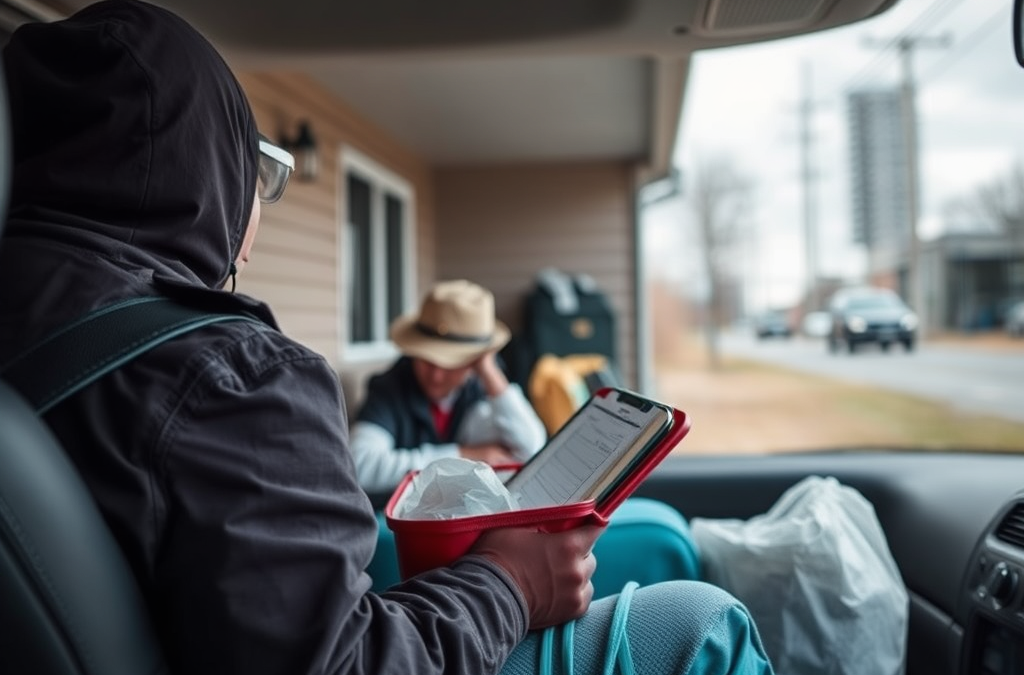
When Deteriorating Conditions Justify an Early Departure
Leaving before an official order is a judgment call based on changing risk, available routes, and the consequences of delay. An order may provide formal direction, but hazards can begin affecting roads, power, communications, air quality, or household mobility before authorities issue one. The practical question is not whether an order has been announced; it is whether remaining in place is becoming less safe while a controlled departure is still possible.
Early movement is more defensible when several signals point in the same direction. Examples include a fire or flood edge moving toward populated areas, repeated official warnings about worsening conditions, a forecast that could close the only usable route, or a household member whose health or mobility makes rapid departure difficult. A family with an infant, oxygen equipment, limited transportation, or animals may need more lead time than a mobile household nearby. Waiting for identical instructions for every household ignores those differences.
The tradeoff is real. Leaving early can expose people to traffic, poor visibility, unfamiliar roads, or an unavailable destination. It can also separate household members if people depart without a clear plan. Staying may be the better choice when the hazard is distant, authorities advise sheltering, roads are already unsafe, or the household lacks fuel and a confirmed place to go. The safest decision is usually the one that preserves options rather than the one that feels most decisive.
Use a simple threshold: if conditions are worsening, your household would need extra time to move, and a viable route and destination are available, prepare to leave rather than waiting passively. If any of those elements is missing, pause long enough to verify information and solve the limiting problem. The purpose of leaving before an order when conditions are deteriorating is to avoid a rushed departure, not to turn uncertainty into unnecessary travel.
How to Verify Risk Before an Order Exists
Reliable verification should combine official information with direct observations that affect your specific location. Check local emergency management notices, weather or hazard alerts, road agency updates, and public safety announcements. Look for the time of the update, the geographic area covered, and whether the message describes current conditions, a forecast, or a precautionary recommendation. An old screenshot can be accurate in wording and still be dangerously outdated.
Do not treat a lack of an order as proof that conditions are safe. Orders can be area-specific, delayed by rapidly changing events, or unnecessary where authorities recommend another protective action. Conversely, a dramatic social-media report does not automatically justify driving toward danger. Confirm the claim through at least one official channel and, when possible, a second independent source. If communications are unreliable, save relevant alerts locally and use battery-powered or vehicle-based information sources without stopping in exposed areas to search for updates.
Translate broad warnings into household-specific questions. Is the road to the destination open, and does it cross the threatened area? Could smoke, flooding, ice, debris, or fallen lines make the route impassable? Is the vehicle fueled, mechanically reliable, and suitable for the expected conditions? Can the destination accept everyone, including pets or someone needing medication? A route that looks short on a map may be a poor choice if it contains one bridge, canyon, low-water crossing, or narrow road.
A useful verification record can be brief:
Write down the source, update time, and affected area.
Mark two possible routes and identify where either could fail.
Confirm fuel, medications, identification, chargers, water, and destination access.
Set a reassessment time instead of repeatedly checking without making a decision.
The common mistake is collecting alarming information without converting it into a location-based decision. A warning becomes actionable when it changes your estimate of route safety, available time, or household vulnerability. That interpretation is more useful than counting how many alerts appear on a phone.
Preparing a Departure That Can Actually Work
A workable early departure plan is short, specific, and executable by the person who may need to act first. Decide who leaves, where everyone meets, which route is primary, which route is secondary, and what condition would trigger a change. Put essential items together before the situation becomes urgent. Packing every possession creates delay and can overload a vehicle; packing only documents and electronics may leave people without medication, water, clothing, or pet supplies.
Prioritize items that are difficult to replace during disruption: prescription medicines, identification, communication devices and charging equipment, critical medical supplies, keys, payment methods, basic clothing, water, food suitable for the household, and necessary infant or animal supplies. Keep the load arranged so that medications and a phone charger are reachable without unloading the vehicle. A small amount of organization can matter if a route closes and the household must stop or change vehicles.
Vehicle preparation deserves a separate check. Fuel level, tire condition, windshield visibility, lights, coolant, and spare-tire access affect whether an early departure remains controlled. A vehicle that starts but has poor tires may be less useful than a delayed departure in a better-maintained vehicle. If fuel is limited, choose the destination and route before leaving; driving around to investigate options can consume the margin that made early travel attractive.
Household roles should be explicit. One person can monitor official updates while another gathers people and animals; someone else can confirm the destination. If a member is away, agree on a meeting point and a message format rather than assuming a phone call will connect. Tell a trusted contact the planned destination, route, occupants, and expected check-in time, while avoiding public posts that disclose an empty home or live location.
For example, a household near a rapidly changing hazard may leave before an order because one resident uses a mobility aid and needs extra loading time. The decision is not based only on fear; it reflects the reduced speed of departure, the possibility of route congestion, and the value of arriving before conditions worsen. The alternative—waiting for a formal instruction—might be reasonable for a nearby household with no mobility constraints, a different route, and a confirmed shelter. Leaving before an order when conditions are deteriorating must account for actual household limits rather than a universal clock.
Travel Risks, Communication, And Reassessment
Departure does not end the decision. Conditions can deteriorate on the road, and a route that was open at the time of departure may later become blocked or unsafe. Drive only when visibility, road conditions, and vehicle capability allow it. Avoid entering standing water, smoke-obscured roads, areas with downed lines, or routes closed by authorities. A detour is not automatically safer if it leads into an unfamiliar hazard area or lacks fuel, services, and communications.
Keep communication purposeful. Send a departure message, a destination update when plans change, and an arrival message when safe. If the phone network fails, do not keep driving while attempting repeated calls. Use prearranged meeting points and contact procedures instead. A paper note in the vehicle or an offline map may be useful when batteries, coverage, or navigation services fail, but it should support—not replace—current official road information.
Reassess at defined points: before leaving, at a safe stopping location, after a route change, and on arrival. Signs that the plan is failing include a road closure, sharply reduced visibility, a vehicle warning light, a passenger medical problem, fuel falling below the return or detour margin, or a destination that can no longer receive the household. Pulling over safely to reassess is preferable to making a complex decision while moving.
Turn back only when doing so is safer and legally possible; do not reverse into a known danger simply because the first plan failed. A third option may exist, such as moving to a designated reception site, a confirmed alternate destination, or a safer nearby location while awaiting updated instructions. Official evacuation routes and shelter directions should take precedence over personal shortcuts when authorities have issued them. Early departure is meant to increase flexibility, but flexibility disappears if every change is improvised.
Common Mistakes And Better Decision Rules
The most damaging mistake is waiting for certainty that cannot arrive before the hazard changes. Another is leaving on the first rumor without confirming route conditions or destination capacity. Both errors confuse information quality with decision quality. A sound choice uses the best available evidence, states what is unknown, and identifies the next condition that would change the plan.
Several weak assumptions deserve correction. “No order means no risk” ignores the time needed by slower households. “Leaving first is always safer” ignores dangerous roads and limited destinations. “The shortest route is best” ignores chokepoints and closures. “Everyone can meet later” ignores lost communications and separated vehicles. Replace each assumption with a check tied to the actual household and location.
A practical decision sequence is:
Identify the hazard: determine what is worsening and how it could affect your home, route, or destination.
Measure remaining options: check usable roads, fuel, mobility, communications, and a place to go.
Set a trigger: choose a clear condition for departure, such as a credible route threat, a worsening official forecast, or loss of a household safety margin.
Depart in an orderly way: take essential supplies, notify a trusted contact, and follow closures and official directions.
Review the plan: reassess only from a safe location and change course when evidence—not panic—requires it.
Practice exposes practical failures before a real event. Confirm that everyone knows where medicines, documents, keys, and carriers are stored. Test the backup route without assuming it will remain open. Check whether the destination has room and whether the vehicle can carry the complete household. A plan that works only when every person, road, phone, and service performs perfectly is not a plan; it is an optimistic sequence of assumptions.
Use leaving before an order when conditions are deteriorating as an option-preservation decision. The priority is not proving that departure was necessary. The priority is reaching a defensible choice while travel, communication, and household movement remain manageable.
Frequently Asked Questions
Is it legal to leave before an official order?
Leaving voluntarily is generally different from ignoring a closure or restricted area, but local rules vary. Follow road closures, access controls, and instructions from emergency officials.
What is the strongest reason to depart early?
A combination of worsening hazard conditions, a household that needs extra travel time, and a confirmed route and destination provides a stronger basis than a rumor or general anxiety.
Should I wait for a second official warning?
Not necessarily. If waiting would remove a safe route or make movement difficult, act on credible current information while continuing to monitor official updates.
What should I do if my planned route closes?
Stop or turn around only from a safe location, check official detour information, and use a confirmed alternative destination. Do not improvise through blocked or visibly hazardous areas.
How should I tell others that I left?
Send a trusted contact your departure time, destination, occupants, route, and expected check-in. Avoid broadcasting real-time location details publicly.
Further Reading
Authoritative Sources
Academy of Nutrition and Dietetics eatright.org
Professional nutrition guidance, healthy eating resources, and practical dietitian-reviewed advice.
U.S. Department of Agriculture usda.gov
Official food, nutrition, agriculture, and consumer guidance from the USDA.
NIH Office of Dietary Supplements ods.od.nih.gov
Research-based fact sheets on nutrients, supplements, dietary intake, and safety considerations.
International Society of Sports Nutrition sportsnutritionsociety.org
Evidence-informed sports nutrition resources and position stands for active people and athletes.
Conclusion
An early departure is most useful when it preserves safe choices for a household facing worsening conditions. Verify the hazard through current official sources, examine the route and destination rather than relying on distance alone, and account for people, animals, medical needs, fuel, and mobility limits. Leave before options narrow when those facts support the decision, but do not drive into a closure or unconfirmed danger merely to avoid waiting. Pack essentials where they can be reached, notify a trusted contact, and reassess from safe stopping points if the road or hazard changes. The practical goal is neither immediate flight nor passive waiting: it is a documented, flexible departure made while the household can still move deliberately.
Why Power Can Become Unstable When Service Returns
Restored electricity is not necessarily steady electricity in its first moments. A utility may re-energize portions of a circuit, clear a fault, adjust switching equipment, or bring other customers’ loads back online. Those operations can produce brief voltage transients or repeated interruptions. A damaged service drop, flooded equipment, loose connection, or problem inside the home can create a different pattern: lights may flicker, appliances may click on and off, or motors may struggle to start.
The distinction between an outage and a surge matters. An outage is a loss of power, while a surge is a short increase in voltage. Restoration can involve both conditions in sequence. A refrigerator may attempt to start, lose power, and try again several times; each failed start places stress on its compressor. Electronic power supplies in televisions, routers, chargers, and control boards may also be exposed to abnormal voltage even when the event is too brief to see clearly.
Do not assume that a single bright flash from a lamp proves a destructive surge, and do not assume that normal-looking lights prove safe power. Household voltage can be abnormal without obvious visual clues. The practical response is to observe the pattern and limit connected loads until service behaves normally.
A useful precaution is to disconnect sensitive devices before power returns if an outage is expected to end soon. Leave computers, televisions, game systems, networking hardware, and nonessential chargers unplugged. If the home has a transfer switch, generator, battery system, or solar equipment, follow that equipment’s documented sequence rather than improvising a changeover. The same principles described in power surges after restoration and appliance protection apply differently depending on the source and wiring arrangement.
Appliance Risks And Warning Signs
Appliance damage depends on the type of load, the duration and magnitude of abnormal voltage, and the condition of the electrical system. Motors in refrigerators, freezers, heat pumps, washing machines, and well pumps are sensitive to repeated short cycling and low-voltage starts. Electronic appliances may fail through damage to power supplies, circuit boards, sensors, or communication modules. A simple toaster is less electronically complex, but its heating element and controls still should not be treated as proof that every outlet is safe.
Warning signs deserve attention even when an appliance still works. Burning odor, warm plugs, discoloration, buzzing, crackling, unexpected resets, dimming displays, circuit-breaker trips, and motors that hum without starting can indicate damage or an electrical fault. Unplug a suspect appliance if it can be done safely, and do not repeatedly reset a breaker to keep it operating. A breaker that trips again may be identifying a continuing problem rather than an inconvenience.
Consider a home where power returns while a freezer, sump pump, air conditioner, and water heater all try to start together. The combined inrush current can create another voltage dip, especially on a constrained circuit or damaged supply. Spacing out loads reduces that immediate demand, but it cannot correct utility-side instability or unsafe wiring. If lights continue to pulse across several rooms, stop reconnecting appliances and contact the utility or a qualified electrician.
Keep an inventory of high-value electronics and appliances, including model numbers and visible condition. That record helps distinguish pre-existing damage from a restoration-related event and supports an insurance conversation if documentation is requested. Avoid the common mistake of testing every device immediately; a working appliance can still be exposed to another disturbance if the underlying supply has not settled.
A Safer Restart Sequence For Household Loads
A controlled restart reduces simultaneous demand and gives you opportunities to notice unstable power. Begin by switching off or unplugging nonessential loads, particularly devices with compressors, heating elements, or large motors. Keep sensitive electronics disconnected. If the electrical panel or service equipment shows water intrusion, scorching, mechanical damage, or unusual noise, do not operate it; arrange a professional inspection.
When the supply appears stable, reconnect devices in an order that favors safety and necessity. Start with basic lighting, then essential communications equipment, followed by one major appliance at a time. Allow a short observation period between motor-driven loads. A refrigerator may need to run normally before a freezer, pump, or air-conditioning system is added. The goal is not a universal waiting time, because conditions vary; the goal is to avoid a simultaneous restart and watch for flicker, repeated clicking, heat, or breaker operation.
A compact restart checklist can keep decisions clear:
Check for water, smoke, odor, heat, damaged cords, and loose plugs.
Leave computers and other sensitive electronics unplugged until voltage appears steady.
Reconnect one significant load at a time and observe its first startup.
Stop if lights pulse, breakers trip, motors hum, or equipment behaves abnormally.
Record the time, symptoms, affected rooms, and appliance behavior.
Generator and inverter systems require special caution. A portable generator must not feed household circuits through an improvised connection, and a transfer arrangement should prevent unsafe backfeed. Automatic systems may transfer differently from utility restoration, so the owner’s manual and installer instructions take priority. A frequent failure mode is treating a surge protector as permission to ignore a tripping breaker or damaged receptacle. Protection devices can limit some transient energy; they cannot repair a loose neutral, overloaded circuit, or failed appliance.
Choosing Protection That Matches The Risk
Appliance protection works best as a layered arrangement. A service-panel surge protective device can address some surges entering through utility conductors, while a listed point-of-use protector can help protect equipment connected at a particular receptacle. Sensitive systems may also be affected through telephone, cable, antenna, Ethernet, or other conductive paths, so the protection design should account for the connections actually used.
Look for a product certified by a recognized testing organization and installed according to its instructions. Panel-mounted equipment generally requires work inside the service equipment and should be installed by a qualified electrician. A plug-in protector should not be daisy-chained with another strip, used with a damaged cord, or placed where it can be covered and overheated. A protector with an indicator light is easier to monitor, but the light is not a guarantee that every protective component remains fully effective.
Tradeoffs matter. A whole-home device offers broad coverage but depends on correct installation, grounding, bonding, and a suitable service configuration. A plug-in unit is easier to add for a home office or entertainment system, but it protects only compatible connected equipment and may not address other wiring paths. Neither option replaces an assessment of recurring flicker or unexplained breaker trips. In an older home, correcting defective wiring may deliver more meaningful risk reduction than adding another inexpensive power strip.
Review protection after a major electrical event, especially if a device indicates failure, smells hot, or has visible damage. Replace a protector that has sacrificed itself rather than continuing to rely on it. For a practical home record, note the installation date, protected circuits, connected equipment, and any restoration symptoms. Comparing surge protection choices for appliances with the home’s actual electrical layout is more useful than choosing by outlet count alone.
For product safety and installation decisions, consult the manufacturer’s documentation, your electric utility’s outage-restoration guidance, and a qualified electrician familiar with the home’s service equipment. Those sources can address local wiring conditions and equipment combinations that a general article cannot verify.
Frequently Asked Questions
Should appliances be unplugged during an outage?
Unplug sensitive electronics and major appliances when practical, particularly if restoration is imminent or the outage involved lightning, equipment damage, or repeated flicker. Leave essential medical equipment connected only under an appropriate backup-power plan.
How long should I wait before turning appliances back on?
There is no universal safe interval. Wait until service appears steady, then reconnect loads one at a time while watching for flicker, clicking, heat, or breaker trips. Continued instability calls for utility or electrician assistance.
Can a surge protector prevent all restoration damage?
No. Surge protective devices may limit some transient voltage, but they cannot correct low voltage, repeated outages, defective wiring, backfeed, or every conductive path into a device.
What appliances are most vulnerable after power returns?
Compressors, pumps, air conditioners, and other motor-driven equipment can be stressed by repeated starts. Electronics with control boards and switching power supplies are also vulnerable to abnormal voltage.
When should an electrician inspect the system?
Request an inspection for persistent flicker, burning odor, warm receptacles, buzzing, water-damaged equipment, unexplained breaker trips, or appliances that hum, reset, or operate abnormally after restoration.
Further Reading
Authoritative Sources
Academy of Nutrition and Dietetics eatright.org
Professional nutrition guidance, healthy eating resources, and practical dietitian-reviewed advice.
U.S. Department of Agriculture usda.gov
Official food, nutrition, agriculture, and consumer guidance from the USDA.
NIH Office of Dietary Supplements ods.od.nih.gov
Research-based fact sheets on nutrients, supplements, dietary intake, and safety considerations.
International Society of Sports Nutrition sportsnutritionsociety.org
Evidence-informed sports nutrition resources and position stands for active people and athletes.
Conclusion
Restored service should be treated as a condition to observe, not a signal to switch every appliance on immediately. Disconnect sensitive electronics, check for physical or electrical warning signs, and bring back significant loads separately so a failing circuit or unstable supply is easier to identify. Whole-home and point-of-use surge protection can complement that process, but only when wiring, grounding, installation, and connected pathways are appropriate. Record unusual behavior and replace protection devices that show failure. Persistent flicker, heat, odor, buzzing, or repeated breaker trips should end the restart process and trigger professional help. A measured restart protects equipment more reliably than a rushed return to normal operation.
Build a Reliable Evacuation Record While Details Are Fresh
A useful post-evacuation record captures what happened in sequence, not merely how the experience felt. Begin with the first warning, the information source that prompted action, the time the household began preparing, the time each person left, and the time the group reached its destination. A simple timeline exposes delays that are difficult to remember later. For instance, a departure that seemed immediate may have included an unplanned search for identity documents, a medication refill, or a missing pet carrier.
Use separate notes for observed facts, decisions, and assumptions. “The road was closed at the west junction” is different from “the road was probably closed because of flooding.” The first can be checked against official notices; the second should remain marked as an interpretation. This distinction prevents a later plan from being built around a mistaken explanation.
Write down successful actions as carefully as failures. A pre-packed document pouch, a charged power bank, or a neighbor’s warning may have reduced confusion. Preserving those details matters because people often redesign a plan by removing frustrating elements while overlooking the small measures that actually worked. A record that lists only problems produces an incomplete lesson.
Keep the first account short enough to finish. A phone note, voice memo followed by transcription, or two-page worksheet is more useful than an ambitious narrative abandoned halfway through. Add timestamps, screenshots of alerts, receipts for emergency purchases, and photographs of relevant conditions when they clarify the sequence. Avoid sharing private addresses, medical information, or identifying details in a public post.
One common mistake is writing the review while exhaustion, fear, or anger is still driving every conclusion. Immediate notes are valuable, but final judgments can wait until everyone has slept and urgent recovery tasks are handled. The goal is not to assign blame. It is to identify where the plan, equipment, information flow, or household expectations diverged from reality. Readers comparing their own experience with lessons to record after a real evacuation should preserve both the first raw account and the later edited version.
Examine Departure Timing, Routes, and Information
Timing records reveal whether the household reacted to a clear trigger or spent too long waiting for certainty. Note when the first credible alert arrived, what threshold was used for leaving, and which tasks consumed the final minutes. A plan may say “leave when advised,” yet the real process may depend on finding a charger, contacting relatives, or deciding whether to secure outdoor equipment. Those dependencies belong in the review.
Route analysis should include more than the chosen road. Record the planned route, actual route, delays, closures, fuel stops, traffic conditions, and points where navigation failed. A route that worked in daylight may be unsuitable in darkness, poor visibility, or heavy traffic. An alternate road may look attractive on a map but lack fuel, reliable reception, safe turnaround points, or access for a large vehicle. Comparing the preferred route with the route actually used shows whether the problem was poor planning or changing conditions.
Information quality deserves its own section. Identify which alerts were authoritative, which messages were delayed, and which informal reports caused confusion. Save the wording and time of important instructions where possible. Official guidance can change as conditions develop, so a household should record not only what it heard but how it decided which source to trust. The useful lesson may be a better alert hierarchy rather than a new piece of equipment.
Consider two competing errors: leaving too late because every detail seemed uncertain, or leaving too early based on an unverified rumor. The correct response depends on hazard speed, local instructions, mobility needs, road capacity, and the consequences of being stranded. A post-event review should not turn one successful departure into a universal rule. It should identify the signals that were available, the signals that were missed, and the point where waiting stopped adding useful information.
Record whether communication worked between household members and outside contacts. Did everyone know the destination? Could a person who became separated find the meeting point? Did low battery, overloaded networks, or unclear wording interfere? A short contact script and a backup method may be more valuable than adding multiple apps. The recording process should explain why a communication step succeeded or failed, not simply label it “good” or “bad.”
Audit People, Supplies, Vehicles, and Property
The most revealing inventory is the one made under real pressure. List what each person needed, what was available, what was inaccessible, and what had to be purchased or left behind. Include medications, mobility aids, glasses, infant supplies, pet items, identification, financial cards, water, food, chargers, and clothing suited to the destination. A supply that exists but cannot be found quickly should be treated as unavailable for planning purposes.
People-related observations are equally important. Record who knew their assignment, who needed hands-on help, who became separated, and which decisions required repeated discussion. A child, older adult, person with a disability, or anxious pet may change the pace of departure more than the packing list suggests. Avoid describing a person as the problem when the actual weakness was an unrealistic timetable or unclear responsibility.
Vehicle notes should cover fuel level, loading time, available seating, child restraints, tire or mechanical concerns, navigation access, and whether a second vehicle created coordination difficulties. A larger vehicle may carry more supplies but take longer to load and maneuver. A single vehicle may simplify communication but create a single point of failure. These tradeoffs should be written down rather than resolved through assumption.
Property actions also need a factual review. Note which doors, windows, utilities, documents, outdoor items, and animals were addressed, and which actions were skipped because time ran out. Do not let property protection delay an urgent departure. The lesson may be to create a short “leave now” sequence and a separate optional sequence for conditions that allow more time. Photographing damage or conditions can support later insurance and repair records, but personal safety and official evacuation instructions take priority.
A compact audit can use four columns: needed, available, reachable, and change required. This exposes a common misconception: a well-stocked home is not automatically an evacuation-ready home. Supplies stored in a basement, documents spread across rooms, or a pet carrier buried behind seasonal items may fail at the exact moment they are needed. Link the findings to specific lessons and revisions, not to a general instruction to “be more prepared.”
Turn Observations Into Specific Plan Changes
A record becomes useful only when it changes a future action, location, trigger, or responsibility. Review each observation and ask: what happened, why did it happen, what consequence followed, and what change would reduce the chance or cost of repetition? “Packing took too long” is an observation. “Move documents and medications into one labeled grab pouch beside the exit” is a testable correction.
Prioritize changes by consequence and reliability. A missing prescription, unsafe route, or inability to account for a household member deserves attention before an inconvenience such as uncomfortable clothing. Favor low-cost changes that remove repeated friction: duplicate critical documents in a secure location, keep chargers with the departure kit, label pet supplies, and write the destination and contact details on paper. More expensive purchases may be justified when the event exposed a genuine capacity problem, but buying equipment should not substitute for clearer decisions.
Use a short action register with five fields:
Finding: the specific event or gap.
Cause: confirmed reason, or a clearly marked hypothesis.
Change: the new action, item, location, or rule.
Owner: the person responsible for maintaining it.
Test date: when the change will be checked in a calm setting.
Testing matters because a correction can create a new problem. Moving all supplies to one location may improve speed but make the kit too heavy. Switching routes may avoid one closure while increasing distance or reducing fuel options. A rehearsal should measure retrieval time, loading order, communication clarity, and whether anyone is overlooked. If the revised process only works when every person is present, it is not complete.
Review the record after official information about the incident becomes available, but do not rewrite firsthand observations to match a later story. Conditions may have changed between neighborhoods, and a route that appeared open at one time may have become dangerous later. Preserve uncertainty where it remains. The strongest lesson is often a modest, specific adjustment that can be maintained: an earlier trigger, a second destination, a printed contact card, or a monthly check of medications and vehicle readiness.
Frequently Asked Questions
When should an evacuation review be written?
Make brief notes as soon as practical, then complete the considered review after urgent recovery and rest. Early notes preserve timing and details; later review improves judgment.
What if household members remember the evacuation differently?
Keep differing accounts and label them by person. Compare timestamps, alerts, receipts, and route records before deciding what can be confirmed.
Should successful actions be included?
Yes. Record actions that reduced delay or confusion so they remain part of the revised plan rather than being discarded during a problem-focused review.
How detailed should a post-evacuation checklist be?
Make it detailed enough to identify a responsible person, location, trigger, and test date, but short enough to use under pressure. Separate urgent steps from optional tasks.
What is the biggest recording mistake?
Turning an assumption into a fact is a common error. Mark uncertain causes clearly and base plan changes on verified conditions whenever possible.
Further Reading
Authoritative Sources
Academy of Nutrition and Dietetics eatright.org
Professional nutrition guidance, healthy eating resources, and practical dietitian-reviewed advice.
U.S. Department of Agriculture usda.gov
Official food, nutrition, agriculture, and consumer guidance from the USDA.
NIH Office of Dietary Supplements ods.od.nih.gov
Research-based fact sheets on nutrients, supplements, dietary intake, and safety considerations.
International Society of Sports Nutrition sportsnutritionsociety.org
Evidence-informed sports nutrition resources and position stands for active people and athletes.
Conclusion
A strong evacuation review preserves the sequence of events, the conditions people faced, and the choices that shaped the outcome. Record warning times, route changes, communication performance, supply access, vehicle limitations, household needs, and unfinished property tasks. Separate observations from explanations, and protect private information when storing or sharing the notes. Then convert the findings into a small action register with an owner and a test date. Prioritize changes that affect safety, medication access, accountability, and departure speed before comfort upgrades or additional gear. Rehearse the revised process under ordinary conditions and keep the successful parts intact. The value of the record is measured by whether the next departure becomes clearer, faster, and more realistic—not by how long the document becomes.